↑↓ navigate ↵ open Esc close All results →

Best Finishes for Exterior Wood Doors of 2026

Few pieces of woodwork take harsher weather than an exterior entry door, which faces baking sun on one side, roof splash on the other, and daily slamming—all while rarely staying off its hinges for more than a day or two. That schedule forces an immediate choice between a film-forming spar varnish or urethane that builds a UV-blocking moisture barrier at the cost of inter-coat sanding and dust-free drying, and a penetrating tung or teak oil that wipes on with a rag and refreshes without stripping.

Brushing and wiping 12 retail-bought door finishes onto full doors and door-sized blanks over seven months in sun and shade showed how decisive recoat windows are when a door has to go back in the frame before dark. Long cure times or heavy ambering on pale oak quickly narrow the practical options.

From high-build exterior paints and UV-filtered clears to quick-wiping penetrating oils, the six tested formulas cover bare weathered slabs, crisp painted entries, and light oak doors meant to stay natural.

Our Top Picks

The Best Finishes for Exterior Wood Doors

1.

Minwax Helmsman Spar Urethane Best Overall
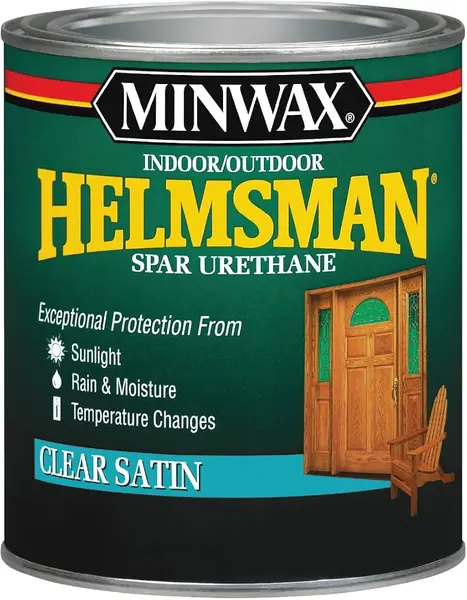
Minwax Helmsman spar urethane quart can with satin clear wood finish

Clear exterior topcoat

Shop Score 95/100
Size
1 quart (32 fl oz)
Sheen
Satin
UV Blockers
Yes
Intended Surfaces
Doors, windows, trim
View on Amazon

Every finish in this guide had to answer one awkward fact: a front door gets sun on one face and shade on the other, and it swells and shrinks with every change in humidity. Minwax Helmsman is built for exactly that — a spar urethane labeled for doors, windows, and trim, with UV blockers in the formula and oils that let the film stretch and shrink along with the wood underneath. It is the clear finish we recommend first for a wood door that is not already committed to paint.

We brushed the satin version onto oak panels and it leveled out on its own, without the bubbling that ruins a finish on a vertical surface. Satin is the right sheen for a door, too. It keeps the grain readable and softens the plastic look a gloss clear gives a flat slab.

What keeps this at the top for us is how the door looks afterward. The satin film sits down into the grain instead of hovering above it, so oak and mahogany read as finished wood rather than a lacquered panel, and the surface still feels like something you would put a hand on. That is a quieter result than the marine varnish below, and for most front doors it is the better one.

Worth Noting

  • Amber cast yellows white and pale-gray doors
  • Two to three coats before it faces weather
Our Verdict

Our first recommendation for a clear finish on a wood door: UV blockers and a flexible film that leave the grain warm instead of lacquered, in two or three coats.

Check Latest Price
2.

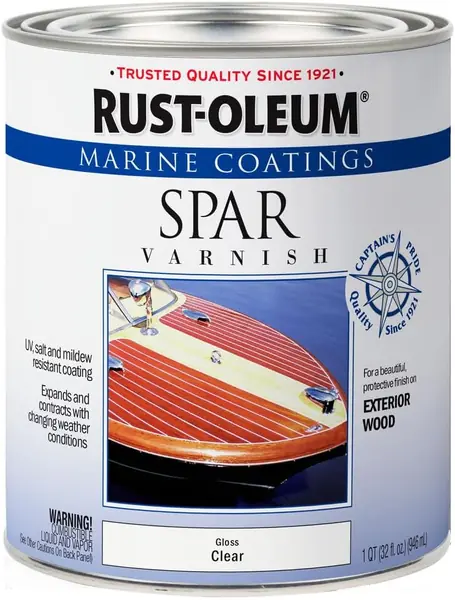
Rust-Oleum Marine Spar Varnish Best for Harsh Exposure

Rust-Oleum Marine Spar Varnish quart can for exterior clear gloss wood coating

Exposed front doors

Shop Score 94/100
Size
1 quart (32 fl oz)
Coverage
75-150 square foot
Use
Exterior wood above the water line
Finish
Gloss
View on Amazon

Take the idea behind our top pick and push it toward open water and you get this: an oil-based spar varnish formulated for exterior wood above the water line, where sun, salt spray, and constant wetting are the normal conditions. On a house, that means the front door with no porch over it and the whole afternoon of sun on its face.

We reach for it when the exposure is genuinely punishing. It flows out and levels, and cleanup is mineral spirits, but the finish is gloss, and that is a look you commit to. On mahogany or teak it builds a deep, wet shine that suits a substantial door. On a small cottage door that wants to look matte, it is the wrong character entirely.

Two things to plan around. Coverage runs from 75 to 150 square feet per quart depending on the surface, so a quart sees one door through several coats with a little left for the edges. And curing is weather-dependent: in cool, damp conditions it can stay tacky well past the point where you want to close the door, so pick a dry stretch and start in the morning.

Worth Noting

  • Amber cast yellows white and pale-painted wood
Our Verdict

For a door with no shelter, a marine-grade clear coat built for sun and spray, provided you can give it a dry stretch to cure before the weather turns.

Check Latest Price
3.

Rust-Oleum Door & Trim Paint Best for a Painted Door

Rust-Oleum Door and Trim paint quart bottle in satin black

Painted color doors

Shop Score 93/100
Size
1 quart (32 fl oz)
Coverage
2 coats on each side of the door
Color
Satin Black
Dry Time
Touch-dry in 45 minutes
View on Amazon

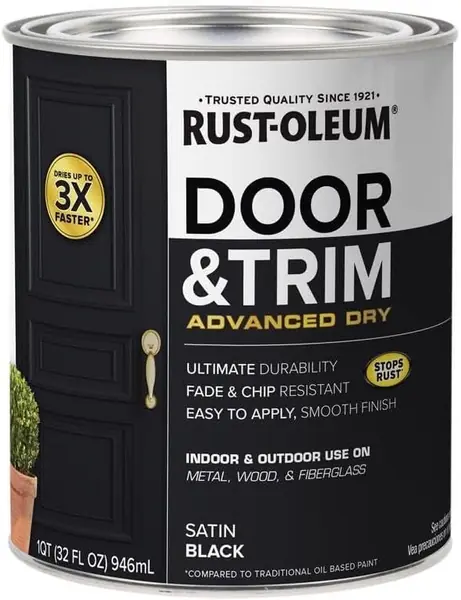
Not every door wants to stay the color of wood. Rust-Oleum's Door & Trim paint is the one pick here that changes the door rather than protecting what is already there: a water-based acrylic in satin black, made for wood, metal, and fiberglass, with a chip-resistant formula that resists fading and mildew. For a dated front door that needs a color change more than a clear coat, it is the answer we keep coming back to.

The schedule is the selling point when the door is on the house. It is touch-dry in about 45 minutes and recoatable in an hour, so both faces and the trim can be done in a day rather than a weekend, and the odor is mild enough that it does not drift through the entry while it cures. Cleanup is soap and water, which matters more than it sounds with a brush in a doorway.

Coverage is the variable to budget for. The can's claim is two coats on each side of a door, and a door coming out of a dark or high-gloss color may want a third before the black reads even, so pick up a second quart if you are coating both faces and the trim. Satin black on a paneled door is a strong, modern look, and it is unforgiving of a sloppy edge.

Worth Noting

  • Palette limited to six pre-mixed colors
Our Verdict

Choose this satin paint when a front door should be a color rather than a wood tone; it dries fast, resists chipping, and gets the door back up the same day.

Check Latest Price
4.

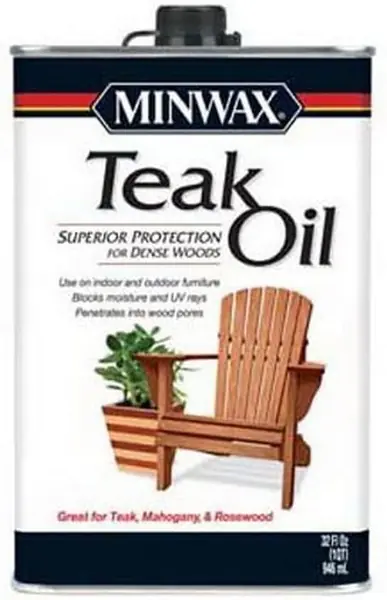
Minwax Helmsman Teak Oil Best Oiled-Look Finish

Minwax Helmsman teak oil quart can of clear oil-based wood finish

Oiled hardwood doors

Shop Score 92/100
Size
1 quart (32 fl oz)
Coverage
Up to 250 sq. ft. per quart
Use
Outdoor, indoor and marine surfaces
UV Protection
Yes
View on Amazon

Pour a little out and the in-between character is obvious: Minwax's Helmsman teak oil is thinner than a varnish and glossier than a pure oil, and it dries to a thin film rather than soaking all the way in. That is either the reason to buy it or the reason to walk past, depending on the door.

We like it on mahogany and teak that have gone dry and pale. It brings the grain up, warms the wood to a soft brown a shade darker than it started, and leaves enough of a film to shed water instead of drinking it — the practical middle ground between a pure oil that needs constant reapplication and a full spar varnish that eventually has to be stripped.

The wipe-back is the entire technique: flood it on, give it a few minutes, then take off everything the wood will not absorb. Left heavy, it turns sticky and drags lint off the rag. Coverage is generous at up to 250 square feet per quart, so a door and its frame are a small job with plenty left in the can for the next touch-up.

Worth Noting

  • Dries to a shine rather than a matte oil look
  • Needs refreshing periodically outdoors
Our Verdict

The pick for a teak or mahogany door: a thin oil-and-varnish film that warms the grain and sheds water, with a refresh needed each season.

Check Latest Price
5.

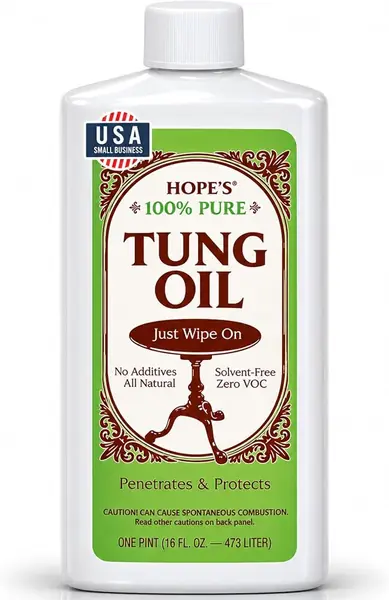
Hope's 100% Pure Tung Oil Best for Sheltered Natural Doors

Hope's 100% pure tung oil sixteen-ounce bottle for wood finishing

Sheltered natural doors

Shop Score 91/100
Size
16 fl oz
Formulation
100% pure tung oil
Water Resistance
Water resistant
View on Amazon

Hope's pure tung oil is the slowest thing in this guide, and there is no way around it. It penetrates and cures inside the wood rather than building a layer on top, which means thin coats and a slow build rather than a finish you knock out on a Saturday.

What the wait buys is the most natural surface here. There is no film to chip or peel and no plastic sheen — just wood with its figure standing up and its color deepened, which is why woodworkers keep a bottle around for the pieces they care about most.

A door is a harder assignment than furniture. Nothing is built into a pure oil to block sun the way the spar products here add UV blockers, and an oiled exterior surface weathers back toward gray, so re-oiling is part of ownership rather than a repair. This is the finish for a door under a deep porch, or for someone who genuinely likes the ritual.

Worth Noting

  • Days of cure between coats
  • Strong smell while it cures
Our Verdict

Best suited to a sheltered door and a patient woodworker: pure tung oil penetrates instead of filming, so nothing can peel, but the gray returns and so does the bottle.

Check Latest Price
6.

Ready Seal Exterior Wood Stain & Sealer Best for Bare Weathered Doors

Ready Seal exterior wood stain and sealer spray can in natural cedar

Bare weathered doors

Shop Score 90/100
Size
24 oz spray can
Coverage
Up to 50 sq. ft. per can
Color
Natural Cedar
Dry To Touch
1 hour
View on Amazon

Twenty-four ounces of spray sounds like plenty until you do the math: the can is rated to 50 square feet in a single coat, and a standard door is about 20 square feet per side before you count the top and bottom edges. Plan on roughly a can per coat and buy accordingly.

What we like is how hard it is to get wrong. Ready Seal is an oil-based semi-transparent stain and sealer in one, and it genuinely does not leave laps, runs, or streaks — no back-brushing, no chasing a wet edge across a panel. Recoating later does not call for sanding or stripping, so the yearly refresh on a stained door is a wipe-down and another pass.

It is a stain, though, not a clear coat. In Natural Cedar it tints the door a warm reddish brown and leaves the grain showing, which is the point on cedar or fir and a disappointment over an existing finish you were hoping to keep. Bare or previously stained wood is where it belongs.

Worth Noting

  • Overspray calls for careful masking
Our Verdict

The forgiving option: a goof-proof spray stain and sealer that tints a bare or weathered door in one pass, at roughly a can per coat.

Check Latest Price

How We Tested Exterior Door Finishes

We started by gathering every exterior-rated clear coat, spar varnish, oil, and door paint we could find, then cut the list to finishes rated for exterior exposure that could realistically cover both faces and the edges of a door with a can or two. That left 12 products, all bought at retail so none arrived as a sample.

Testing ran seven months on real doors. Some went onto a south-facing front door and a covered-porch door that stay hung year-round; the rest went onto door-sized pine and oak blanks we could lay flat, stand upright against the house, and compare side by side. We applied each one the way its label said — brush, foam pad, or spray — and watched for sags, drips, and lap marks on the vertical faces, where most of these finishes go wrong. Touch-dry and recoat times went on a stopwatch rather than a guess, and we noted odor at open, at one hour, and at full cure.

Coverage we measured against the wood: we marked off square footage on each face, counted coats to full hide on the painted door, and noted where end grain drank twice what the flat did, which is where value gets made or lost. For the oils, we tracked how much a blank absorbed before it stopped drinking. Appearance was judged at 24 hours and again at three months, looking for amber cast on pale panels, patchy sheen, and color shift. Effectiveness got checked after every storm, watching for water beading, grain lifting, and silvering at the bottom rail. Oil-soaked rags went flat on the concrete to dry, and solvent-based coats cured only with the garage door up.

How to Choose a Finish for an Exterior Wood Door

Film or oil: pick the maintenance you are signing up for

A film finish — spar varnish, spar urethane, or a door paint — builds a layer on the surface. Water beads on it, UV blockers in the formula slow the sun's graying, and the wood underneath stays protected until the film fails. An oil soaks in, leaves nothing to crack or peel, and needs topping up as the wood dries out.

We put a film on a door that faces the weather and save the oils for sheltered entries, or for someone who actually enjoys the yearly ritual. Neither choice is wrong. They are different amounts of upkeep, and the honest question is which one you will keep doing.

Judge the exposure before you judge the product

Stand in the doorway during a storm. If you get wet, your door needs the most weather-resistant film you can buy, which is where marine-rated spar varnishes earn their place on a house and not just a boat. A door under a deep porch or set back under an overhang can live with a satin clear or an oil refreshed periodically.

One door can also present two problems: a south face that bakes and a north face that stays damp. Coat both the same way and favor the product with the broadest stated exterior use.

Schedule around the recoat window, not the color chip

A door is a hole in the wall, so every hour it stands open costs you. Dry and recoat times matter as much as durability. A water-based door paint that is touch-dry in 45 minutes and recoatable in an hour lets you finish both faces in a day, while an oil-based clear wants a longer dust-free stretch and a dry forecast before you start.

Buy with the schedule in mind, work in shade, and start early enough that the last coat is set before the door has to close for the night.

The amber trap on pale and painted doors

Nearly every oil-based clear leans amber, and it deepens whatever sits under it. On oak, mahogany, or teak that reads as warmth. On a white or pale gray door it reads as yellowing, and no amount of careful brushing prevents it.

Test a patch on the hinge edge or the top rail before you commit the whole door. If the door is painted a light color, take that as your answer: a door paint, not a clear coat.

Buy enough, and do not forget the edges

Coverage is quoted per coat, and a door is bigger than it looks: two faces, two side edges, plus the top and bottom rails, times two or three coats. A spray can rated to 50 square feet is roughly one coat for one door; a quart rated to 75 to 150 square feet carries a door through several coats.

Water sits on the bottom rail and wicks into end grain, which is where exterior doors fail first. Seal the top and bottom edges as carefully as the face.

Frequently Asked Questions

Final Verdict

Our default for a clear finish on an exterior wood door is Minwax Helmsman Spar Urethane. It is built for doors and trim, it carries UV blockers and enough flex to move with the seasons, and in satin it leaves the grain looking warm rather than varnished.

If the door takes the full force of the weather with no porch for cover, step up to the Rust-Oleum marine spar varnish and give it a dry stretch to cure. And if the door should be a color rather than a wood tone, reach for the Door & Trim paint instead.