↑↓ navigate ↵ open Esc close All results →

Best Finishes for Live Edge Wood of 2026

A live-edge slab leaves zero margin for a bad test coat, because the bark line, natural checks, and figure are one-of-a-kind. A finish that looks crisp on a flat test block can still pool inside open cracks or turn gummy along rough cambium while shifting the wood's tone far more than expected.

Six months of applying 14 two-part hardwax oils, one-part blends, pure oils, and water-based film topcoats to walnut, oak, and maple slabs underscored one habit: test on the underside first, since chemistry alters color more dramatically than sheen level. Calculating real cost per square foot and watching how cleanly each formula settled along fragile bark edges separated reliable slab finishes from messy ones.

Penetrating oils preserve natural texture and spot-repair easily on dining tables, while cured film topcoats lock down bark edges and block spills on heavy-use counters.

Our Top Picks

The Best Finishes for Live Edge Wood

1.

Rubio Monocoat Oil Plus 2C Best Overall
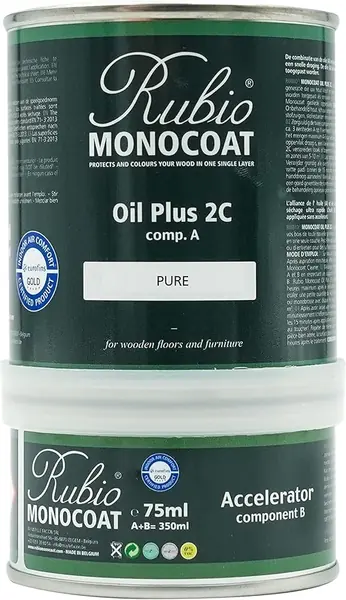
Rubio Monocoat Oil Plus 2C hardwax oil can with accelerator in Pure

Interior slab tables

Shop Score 98/100
Sheen
Matte
Coverage
105-175 sq ft
Base
Linseed oil hardwax
Coats
Single coat
View on Amazon

A big slab gives you a lot of awkward surface to cover: the planed face, the sawn ends, and an edge that changes height every few inches. Rubio's whole pitch is that all of it takes a single layer. Nothing builds up on the surface, so there is nothing to sand between coats and no dark lap line where one pass meets the next — the flaw that shows up when you brush a film across a four-foot top in sections.

The look is why it stayed at the top of our list. At its matte sheen the slab reads as wood, grain and saw marks and all, without the plastic sheen a polyurethane leaves behind. The linseed base carries no VOC, and the finish is certified for food contact and for toys once cured, which is the kind of reassurance we want under a dining table.

Plan for the two-part routine. You mix the accelerator into the oil and work through the batch inside its window, so small cups and section-by-section application beat mixing a whole container at once. Coverage is where the cost math turns: one small can is rated for 105 to 175 square feet, enough for a full-size slab top with some left over.

The quiet advantage shows up a year later. Because a hardwax oil lives in the wood instead of on it, a worn spot along an edge can be scuffed back and re-oiled to blend in, rather than sanded down to bare wood and refinished whole. On a one-off slab you cannot replace, that option is worth something.

Worth Noting

  • Premium outlay for a small can
  • Rated for interior projects only
Our Verdict

We recommend Rubio for the interior slab you want to look like wood rather than lacquer: one coat, no lap marks, and coverage that goes a long way toward justifying the price.

Check Latest Price
2.

Odie's Universal Oil Best No-Mix Hardwax Oil

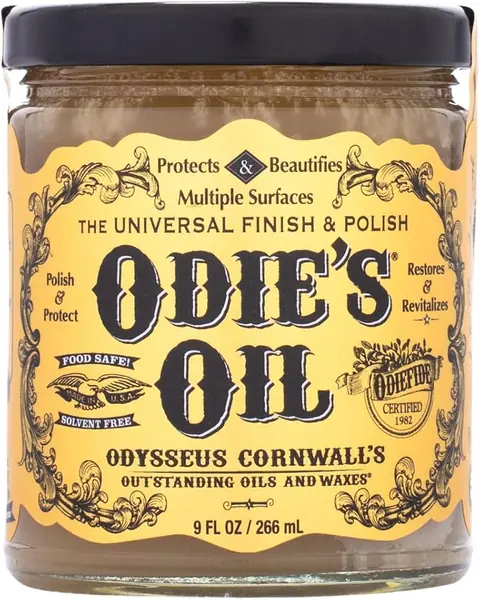
Odie's Universal Oil nine-ounce jar of solvent-free hardwax wood finish

Epoxy river tables

Shop Score 97/100
Sheen
Buff to any sheen
Coverage
270+ sq ft
Container
9 oz
Food Contact
Safe once cured
View on Amazon

What we appreciate about Odie's is everything it does not require: no accelerator to measure, no solvent smell drifting through the shop, no pads or special tools. Open the jar, wipe it on with a rag, buff it off. For someone finishing one slab in a garage, that simplicity is worth real money.

On wood it behaves like a feeding oil with a wax body. It soaks in, deepens the grain a shade, and buffs to a soft sheen that sits closer to a well-kept cutting board than to a lacquered table. It stays in the wood rather than on it, which is exactly what a natural edge wants, since there is no flat surface there for a film to grip.

Buffing is the step that decides the outcome. Put it on thin, let it sit, then take the excess off rather than leaving a wet layer behind — a heavy coat can stay tacky well into the next day. Two thin rounds a day apart beat one wet one every time we have tried it.

The multi-surface claim earns its keep on modern slabs. If yours has an epoxy river, a steel base, or a stone foot, the jar is rated for all of them, so you are not taping off half the piece to keep finish off the wrong material.

Worth Noting

  • Highest outlay in this group
Our Verdict

We like Odie's when you want a hardwax oil without measuring anything: open, wipe, buff, and the same jar covers the epoxy river and the steel base.

Check Latest Price
3.

General Finishes High Performance Topcoat Best Film Finish

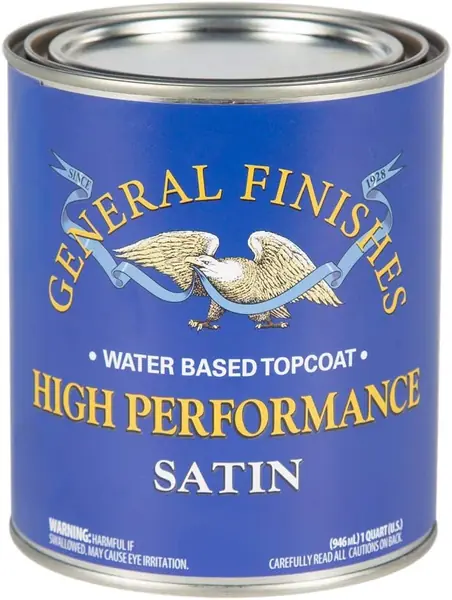
General Finishes High Performance water-based topcoat quart can in satin

Hard-use dining tables

Shop Score 96/100
Sheen
Satin
Coverage
125-150 sq ft per quart
Use
Interior only
Recoat
1 to 2 hours
View on Amazon

Once a slab becomes the table your household actually eats on, the question stops being how the finish looks and starts being what happens when a glass sweats on it overnight. A film topcoat answers that in a way an oil cannot, and this is the film we reach for first.

It builds a hard, clear surface at 125 to 150 square feet per quart. Three coats is the usual target, with a light scuff between them and only an hour or two of waiting, so a tabletop is done in a day rather than spread across a week of evenings.

The satin version is the reason we recommend it for slabs. It has a soft sheen that does not turn figured walnut into a mirror, and it stays clear instead of pushing pale maple toward amber the way an oil-based finish does. On a live edge top the finish does feel like a surface — that is the trade you make for the protection.

Two practical notes before you open the can. The label's temperature and humidity range is not a suggestion with a water-based clearcoat; applied cold or in damp air it can dry cloudy, so heat the shop or wait for a better day. And it goes on thin, so the third and fourth coats are what actually build the wear layer.

Worth Noting

  • Rated for interior use only
Our Verdict

We point anyone finishing a hard-working dining table to this topcoat: three coats in a day and a satin film that shrugs off spills instead of soaking them up.

Check Latest Price
4.

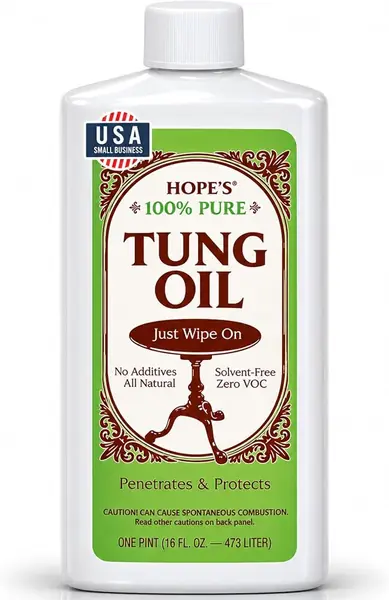
Hope's 100% Pure Tung Oil Best Penetrating Oil

Hope's pure tung oil sixteen-ounce bottle of food-safe wood finish

Food-contact pieces

Shop Score 95/100
Container
16 fl oz
Use
Interior and exterior
Food Contact
Safe when fully cured
Type
100% pure tung oil
View on Amazon

Pure tung is the finish a lot of slab makers reach for before they try anything else, and this is the uncomplicated version: one ingredient, no thinners, no metallic driers to hurry it along.

We like what it does to a raw top. It soaks in, pulls the figure up, and leaves a low satin glow you can still feel the wood through. Nothing sits on the surface to chip, so there is no white line to chase along a live edge a year from now. The price is time, and it is not small.

Work in thin coats with days between them; the oil cures by taking on oxygen rather than by flashing off solvent, so a cold shop stretches the wait further. Wipe off every bit of excess, because anything left pooled will cure gummy. Once it is fully cured it is safe for cutting boards and counters, and it holds up outdoors as well as indoors.

The first coat will look like nothing happened. The second and third are where the depth arrives, and a slab that gets a fresh thin coat once a year keeps its looks without ever needing to be stripped back to bare wood.

Worth Noting

  • Little surface build for hard use
  • Darkens pale woods slightly
Our Verdict

For a slab you want to feel under your hand, we choose pure tung oil and build the drying time into the schedule from the start.

Check Latest Price
5.

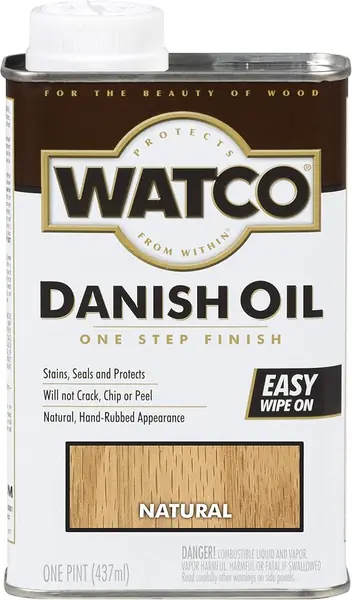
Watco Danish Oil Best Budget Pick

Watco Danish Oil natural pint bottle for interior wood finishing

Budget slab projects

Shop Score 94/100
Sheen
Hand-rubbed glow
Coverage
67-100 sq ft
Type
Oil and varnish blend
Dry To Touch
As little as 6 hours
View on Amazon

Danish oil is the value play here, and we mean that as a compliment. You get a blend of oil and varnish in one can, you wipe it on and wipe it off, and a small slab goes from bare to finished in an afternoon rather than a weekend.

The varnish in the blend is what separates it from a pure oil. It hardens inside the pores and gives the surface some resistance to spills and abrasion instead of only feeding the wood. Watco rates it dry to the touch in as little as six hours, with 67 to 100 square feet of coverage per pint.

It suits tight-grained slabs best. Walnut, cherry, and maple take the blend evenly and come up with a warm, hand-rubbed glow; open-pored oak drinks it and may want a third application before the surface stops looking dry.

Upkeep is a genuine part of the appeal on a table. When the top starts looking parched, wipe on another thin coat and buff it off. There is no film to sand back and no edge to feather into the old finish.

Worth Noting

  • Amber cast on pale woods
Our Verdict

Our budget pick: oil and varnish in one can, a six-hour recoat, and a warm hand-rubbed look that makes a first slab project feel easy.

Check Latest Price
6.

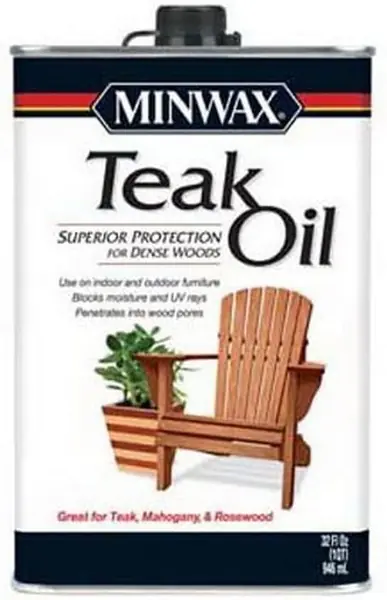
Minwax Helmsman Teak Oil Best for Outdoor Slabs

Minwax Helmsman teak oil quart can for exterior wood protection

Outdoor slab furniture

Shop Score 93/100
Coverage
Up to 250 sq ft per quart
Container
1 quart
Use
Interior, exterior, marine
UV Protection
Built in
View on Amazon

An outdoor slab lives a different life: sun on one face, rain on the other, and a drift toward silver within a season if nothing is on it. Interior oils carry no UV blockers. This one does, and it is rated for exterior furniture and for marine surfaces above the waterline.

It penetrates dense woods and leaves a water-repellent layer behind, with a quart covering up to 250 square feet. Cedar, teak, and ipe all take it, and a bench or a porch table comes back to a warm golden tone instead of the gray it had weathered to.

What we noticed on a test piece is how much it behaves like a thin varnish rather than a pure oil. It does not soak all the way in; it leaves a film that beads water, which is exactly what makes it useful outside and also what makes it the wrong choice for an interior show table where you want to feel raw wood.

Application is where people get into trouble. Thin coats, worked in, with every bit of excess wiped off — a heavy coat in cool, damp weather can stay tacky long enough to collect dust and lint, and then you are sanding a sticky surface instead of enjoying the piece.

Worth Noting

  • Needs periodic recoating outdoors
Our Verdict

If the piece lives outdoors, this is what we use: UV blockers, water resistance, and a quart that covers a big table for very little money.

Check Latest Price
7.

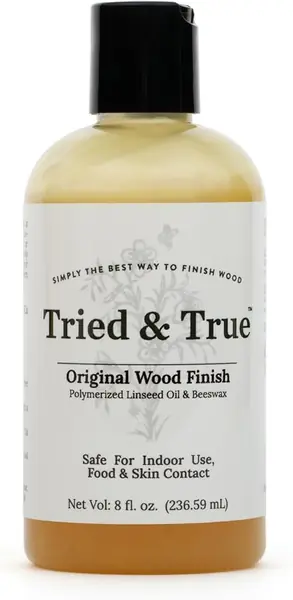
Tried & True Original Wood Finish Best for Small Food-Safe Pieces

Tried & True Original eight-ounce bottle of linseed oil and beeswax finish

Small food-safe pieces

Shop Score 92/100
Sheen
Matte
Container
8 fl oz
Food Contact
Safe once cured
Base
Polymerized linseed oil and beeswax
View on Amazon

Two ingredients: polymerized linseed oil and filtered beeswax. No solvents, no metallic driers, nothing that demands a respirator or a propped-open garage door while you work.

Application is slower than a wipe-on oil and simpler than a film. Sand to 320 or finer, wipe it on, buff it dry, wait a day, burnish with fine synthetic wool, then repeat until the surface stops drinking. It spreads further than the bottle suggests, and the buffing is what produces the finish rather than the wet coat.

The look is warm and low: a soft matte that deepens cherry and walnut a shade and leaves oak looking oiled rather than coated. It is food safe once cured, which is why we keep it for boards, knife handles, and small slabs that get handled more than they get looked at.

Where it earns its shelf space in a shop is repair. A worn spot on a board or a table edge takes another thin coat and blends in, with no stripping and no sanding back to bare wood — the reason a linseed-and-wax finish has stayed in use as long as it has.

Worth Noting

  • Eight ounces is small for a dining table
  • Slow build with days between coats
Our Verdict

We reach for Tried & True on boards, utensils, and small slabs, where a linseed-and-beeswax finish with no solvents makes more sense than a film.

Check Latest Price
8.

Minwax Polycrylic Protective Finish Best for Small Bright Projects

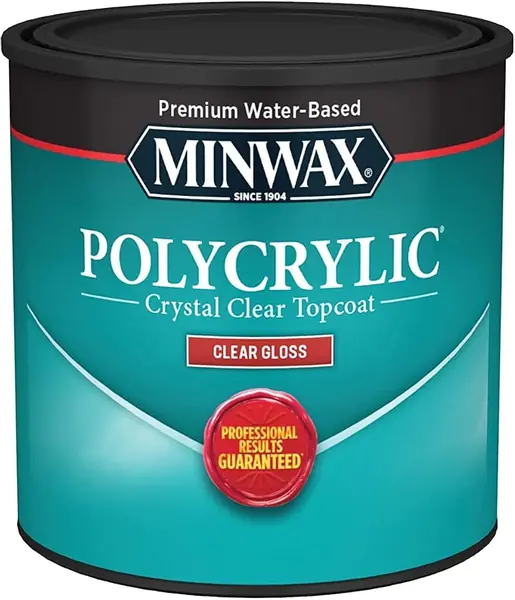
Minwax Polycrylic clear gloss water-based protective finish half-pint can

Small bright projects

Shop Score 91/100
Sheen
Gloss
Coverage
Up to 150 sq ft per half pint
Recoat
2 hours
Cleanup
Soap and water
View on Amazon

Gloss is a decision, not a default. On a slab it amplifies figure and chatoyance, the shimmer that moves as you walk past, and it also turns every dust nib and brush mark into a highlight. Whether that trade is worth it depends entirely on the piece.

The practical case is speed and cleanup. It is water-based, recoats in two hours, and washes out of a brush with soap and water. A half pint covers up to 150 square feet, and the finish stays clear over pale woods like maple and ash instead of adding an amber cast.

Where it fits best is a shelf, a small side table, a first slab, or a piece in a bright room that can carry a shine. On a big dining top the gloss reads as lacquer, and a satin oil looks more like the tree it came from.

Our take is that it is the inexpensive way to get a hard, clear coat onto a small project in an afternoon, and it holds its clarity over light woods better than we expected. It is just not the finish we put on a slab we care about.

Worth Noting

  • Not for exterior projects
Our Verdict

We keep Polycrylic for small, bright projects: cheap, fast, water-cleanup, and clearer over pale woods than most finishes at the price.

Check Latest Price

How We Tested Live Edge Wood Finishes

We built the shortlist by reading labels the way a buyer should: solids content, interior or exterior rating including UV protection, food-contact claims, recoat window, and stated coverage per container. Then we did the math nobody enjoys and converted each one to cost per square foot, so a small tin and a full quart were judged on the same footing. That narrowed the field to 14 finishes, which we tested over six months.

Each finish went onto sanded offcuts of walnut, oak, and maple plus full pieces: a dining table, a kitchen counter, a floating shelf, and an outdoor bench that sat on a covered porch. We spread it over a measured patch at the label's rate to see whether the coverage claim held, and we watched how it behaved at the bark edge and in natural checks — whether it pooled, whether it needed a second pass to keep from drying chalky, and whether a one-part product saved real time over mixing a separate catalyst.

Recoat windows ran on a timer, and we logged the full time before a piece could be used. Food-contact pieces stayed out of service until the label's full cure had passed, and those boards were hand-washed only, never in a dishwasher. Oil-based products went on with the shop doors open and fans running, and we noted how long the smell lingered. Texture we judged by hand after buffing — waxy, tacky, glassy — and color shift and sheen by before-and-after photos shot under the same light.

Last, we sanded small patches on cured pieces and reblended them to see whether a finish could be spot-repaired without stripping the whole slab, and we checked the outdoor bench for fading and water beading after rain. Every piece stayed in the house in daily use so we could see how the surface wore.

How to Choose a Finish for Live Edge Wood

Film or Oil: Decide What Kind of Protection You Want

A film finish such as polyurethane, polycrylic, or shellac lays a coat on top of the wood. A penetrating oil or a hardwax oil goes into it. On a live edge slab the difference shows up at the edge and at every check: a film has to bridge a crack and move with the slab underneath, while an oil moves with the wood because it is in the wood.

We choose a film when the slab is a dining table that takes spills and scrubbing, and a hardwax oil when the whole point of the piece is the wood itself. For boards and counters, a pure oil is the safer bet. A paste wax on its own is a luster coat rather than protection — put it over an oil if you want the hand-rubbed look.

Match the Sheen and the Color Shift

Sheen decides whether a slab reads as furniture or as a tree. Matte and satin keep the grain readable and hide dust; gloss lifts figure and chatoyance but shows every nib and can look lacquered on a large top.

Color shift is the other half of the decision. Oils and oil-and-varnish blends warm the wood toward amber, which flatters walnut and cherry and changes pale maple; water-based clears stay closer to the wood's own color. Judge both on a cutoff from the same slab, sanded to your final grit and finished, and look at it in the room's light — end grain always goes darker than the face.

Budget the Drying Time, Not Just the Money

Recoat windows run from an hour or two for a water-based film to days for a pure oil, and that schedule decides whether a slab is finished this weekend or next month. Finishing is the last step, and it is the one that sets the piece aside.

The trap is dry to the touch. A film that feels dry can still be soft underneath, and an oil that has stopped being tacky is still curing. Leave the piece alone longer than feels necessary, and keep rugs, plants, and cardboard off a new finish — they trap moisture and print marks into it.

Buy Enough for Two Coats and Compare Cost per Square Foot

Coverage figures are quoted for a smooth surface. A raw slab drinks more, and the edges and ends take extra, so measure the top, add the edge, and buy for two coats rather than one.

The trap here is price per ounce. A small can of hardwax oil rated for 105 to 175 square feet is cheaper per square foot than a large can of film that needs four coats — the Rubio and Odie's jars both look expensive on the shelf and go much further than their size suggests. Buy it all at once so sheen and color match.

Plan for Food, Weather, and Repairs

If the piece will meet food — a board, a counter, a serving slab — choose a finish labeled food safe and let it cure fully before use. Hand wash it afterward rather than putting it in the dishwasher, which strips the finish.

If it lives outside, only a finish with UV blockers keeps the wood from going gray, and it will need refreshing as the weather takes it back. And think ahead: an oil or hardwax finish can be spot-repaired, while a film has to be scuffed and recoated across the whole surface.

Frequently Asked Questions

Final Verdict

Rubio Monocoat Oil Plus 2C is the finish we recommend for most interior live edge slabs. One coat goes down without lap marks, the matte result looks like wood rather than lacquer, and a small can covers enough square footage to take the sting out of the premium price.

If the slab is a dining table that takes daily abuse, General Finishes High Performance builds the harder surface. And if the piece lives outdoors, skip both — Minwax Helmsman Teak Oil is the pick here that carries UV protection and stands up to weather.