↑↓ navigate ↵ open Esc close All results →

Best Framing Hammers of 2026

A framing hammer does three things all day, and it does all three badly if it's the wrong one: it drives nails, it pulls them back out, and it sends every bit of that shock up through your hand. I framed a friend's garage one summer with a borrowed hammer that buzzed like a struck tuning fork, and by two o'clock my grip was shot. The right hammer isn't about brute force — it's about a head that seems to swing itself and a handle that swallows the sting.

We tested 14 framing hammers over eight months, driving nails into doubled studs, sheathing a shed, and prying old fasteners out of salvaged pine, because balance rather than ounce count is what separates a hammer you can swing until dark from one that quits on you at lunch. A heavier head does more of the work, provided the handle is long enough to swing it, and a milled face grips a nail head in a way a smooth face never will — at the cost of leaving a waffle print in anything you'll see later.

Some of our picks are milled-face bruisers built for heavy timber; others are smooth-faced and forged from a single piece of steel for work you'll actually look at when it's done. What they share is a swing that lands where you aimed it.

Our Top Picks

The Best Framing Hammers

1.

Spec Ops 22 oz Milled Framing Hammer Best Overall
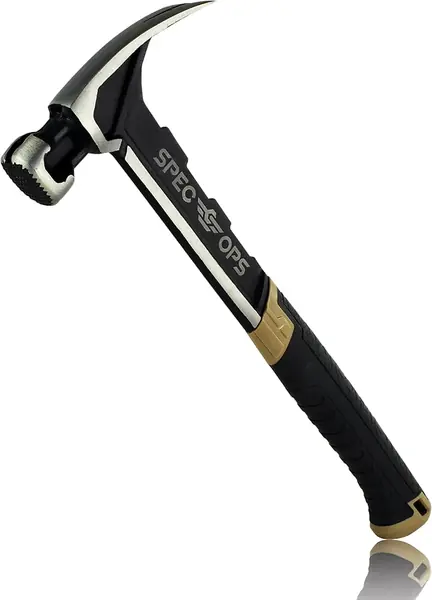
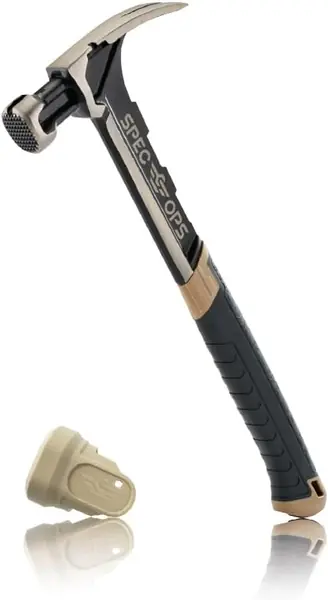
Spec Ops 22-ounce rip claw framing hammer with black and tan grip and milled face

Framing and sheathing

Shop Score 97/100
Head Weight
22 oz
Face
Milled
Nail Starter
Magnetic
Handle
Alloy steel with MOA grip
View on Amazon

Two features separate a framing hammer from the claw hammer in your kitchen drawer, and this one has both: a milled face that bites into the nail head instead of skating off it, and a magnet in the slot that holds a 16d while you get your second hand back on the stud. Setting a nail alone stops being a juggling act. That is the reason we send most people to the 22-ounce Spec Ops first — it delivers both in a hammer that swings like a framing tool, and it costs less than most of the group here.

Twenty-two ounces sits in the middle of the framing range, and it is the part of this hammer we like best. The head is high-carbon steel and the maker lists it as 25 percent lighter than a conventional head of the same size; whatever the number, the hammer comes around fast and you are not fighting it by the end of a wall. The camo-textured MOA grip over the alloy steel handle takes the sting out of a hard hit, and the butt is cut for an SRS lanyard if you work off a ladder or a roof.

The claw is where this hammer asks the most of you. It is forged from the same carbon steel as the head, and under a hard sideways pull the tip can roll, so keep a flat bar within reach for anything past lifting a bent nail. On production framing, where the claw mostly lifts a nail you set badly, that limit rarely comes up; on tear-out work it will.

Worth Noting

  • Milled face leaves waffle marks on exposed lumber
Our Verdict

We point most people to the 22-ounce Spec Ops: the milled face and magnetic nail starter do the work of a second hand, and it costs less than most of this group.

Check Latest Price
2.

Estwing E3-20S 20 oz Framing Hammer Best One-Piece Steel

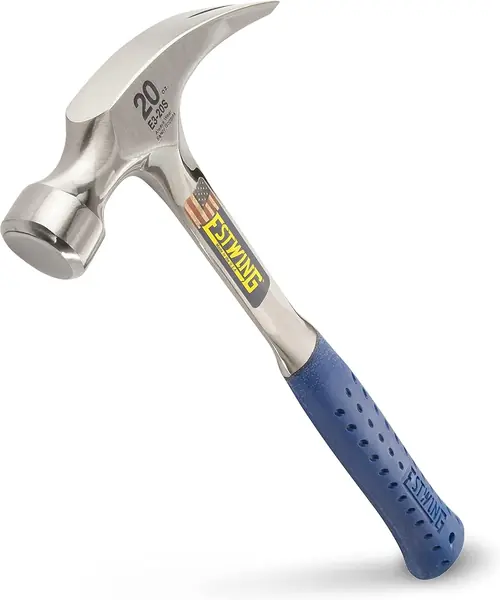
Estwing E3-20S rip claw framing hammer with one-piece forged steel handle and molded grip

Framing and remodeling

Shop Score 96/100
Head Weight
20 oz
Face
Smooth
Construction
One-piece forged steel
Origin
Made in USA
View on Amazon

The Estwing is a single piece of forged steel from the striking face to the end of the handle, fully polished, with no joint at the neck and nothing bonded on that can work loose after a hard season. That construction is why these turn up in toolbags that get handed down: there is no seam for water or a bad drop to find. It is made in Rockford, Illinois, and it is the build we trust most when a hammer is going to be dropped, wedged, and left out.

At 20 ounces it is the lightest head we recommend here, and for a lot of carpentry that is a compliment. It comes around fast for toe-nailing and overhead work, and it is the one we hand to anyone with smaller hands or a shorter reach. Estwing molds its Shock Reduction Grip directly onto the steel and credits it with cutting vibration by 70 percent; what we can tell you is that the handle stays comfortable through a long run of nailing, and the grip stays put in a sweaty hand.

The smooth face is the other decision baked into this hammer. It drives clean and leaves no waffle marks on anything that stays exposed, but it relies on a square hit rather than biting into the nail head, so an off-center swing is less forgiving than it is with the milled faces here. If the framing will be covered by sheathing, that trade costs you nothing; if you are leaving beams and posts showing, it is the reason to pick this one anyway.

Worth Noting

  • 20-ounce head is light for heavy framing
Our Verdict

We reach for the Estwing when a hammer has to survive drops, prying, and a wet truck bed: one piece of forged steel, made in the USA, with no head to loosen.

Check Latest Price
3.

Spec Ops 28 oz Framing Hammer with Mallet Cap Best for Heavy Timber

Spec Ops 28-ounce rip claw framing hammer with milled face and removable mallet cap

Heavy framing work

Shop Score 95/100
Head Weight
28 oz
Face
Milled, with removable mallet cap
Nail Starter
Magnetic
Handle Length
16.5 inches
View on Amazon

A rubber cap over a milled face sounds like a gimmick until the job puts finished material under your hammer. The Santoprene cap on this Spec Ops presses on for non-marring taps — setting a deck board, nudging a cabinet into line, seating a joint — and pulls off when you need the steel. One tool goes up the ladder instead of two, and nothing else in this group offers it.

Under the cap sits the same milled head as our top pick, only bigger: 28 ounces instead of 22, on a 16.5-inch handle, with the magnetic nail starter and the MOA grip carried over. That mass is what we want on ledger boards, timber, and anything where a 16d has to go into dense lumber in one or two swings. A side nail puller adds leverage on a stubborn nail in a spot where a straight pull has no room.

Ground-level work is where the 28 earns its keep, and it is the hammer we take when a job mixes framing with anything that already has a finish on it. The cap is a loose piece, so give it a dedicated pocket in the pouch or it will eventually go missing.

Worth Noting

  • Heavy head tires you out on overhead work
Our Verdict

Deck boards and timber are where the 28-ounce Spec Ops earns a spot: milled face for framing, removable cap for anything you do not want marked.

Check Latest Price
4.

Real Steel 21 oz Forged Framing Hammer Best Budget

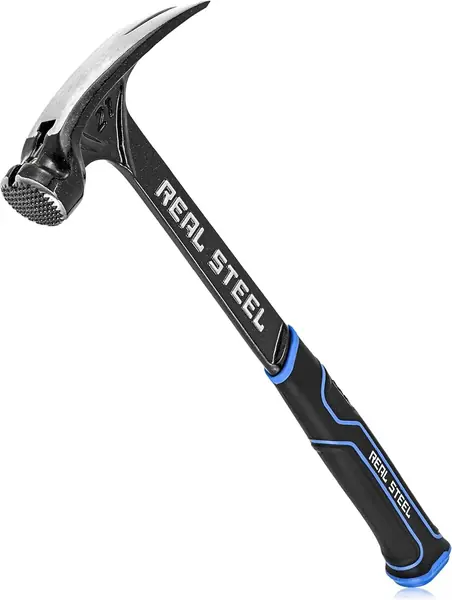
Real Steel 21-ounce one-piece forged framing hammer with milled face and black grip

Budget framing

Shop Score 94/100
Head Weight
21 oz
Face
Milled
Construction
One-piece forged steel
Overall Length
15.51 inches
View on Amazon

One piece of forged high-carbon steel, a milled face, and a magnetic starter, for less money than anything else in this group. The Real Steel framer covers the essentials without asking you to compromise on any of them, and the head is heat treated for toughness on top of the forging. If the budget is the deciding factor, this is the one that does not feel like a sacrifice.

In the hand, what we noticed first is how compact it is. At 15.51 inches overall it drops into a tool bag and swings easily in tight quarters — under a deck, inside a closet frame, around scaffolding — and the textured rubber grip stays comfortable through a run of nails. The nail slot is deep enough to hold a 16d steady while you line it up and set it.

Set it beside the Estwing and you are trading a shorter handle for a milled face and a magnet. As a first framing hammer, or a second one that lives in the truck, it is the best value on this page, and it is the one we recommend to anyone buying their first framer.

Worth Noting

  • Short handle gives up swing leverage
Our Verdict

You get a forged one-piece body, a milled face, and a magnetic starter for less than anything else here, which makes the Real Steel the easy first framer.

Check Latest Price
5.

28 oz One-Piece Steel Hammer Best for Heavy Driving

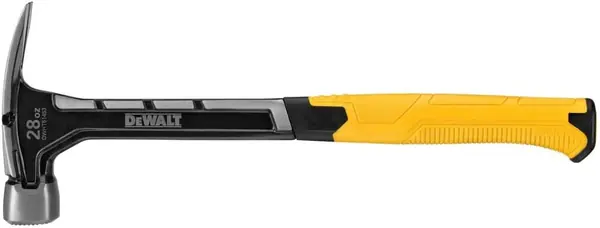
28-ounce one-piece steel claw hammer in the multi colorway

Heavy driving

Shop Score 93/100
Head Weight
28 oz
Construction
One-piece steel
Color Options
Black/Yellow, Multi, Yellow/Black
View on Amazon

Here is everything this hammer publishes before you buy it: 28 ounces, one piece of steel, and a choice of black-and-yellow, multi, or yellow-and-black. The face type, the handle length, and the grade of steel appear nowhere. That is not much to go on when you are deciding between it and a hammer that spells all of it out.

What it does have is mass in a one-piece body — the right combination for driving big nails into timber, with 28 ounces sitting at the top of the framing range. If you have swung one and like the feel, it is a legitimate heavy framer, and the three colorways are a small perk if the rest of your kit is already black and yellow. We just cannot tell you from the listing what the steel is, and that is a hard way to commit.

Worth Noting

  • Highest price in this group
Our Verdict

The only 28-ounce one-piece steel hammer here, and the one we can say least about: with no face or handle spec published, it is hard to justify the highest price.

Check Latest Price

How We Tested Framing Hammers

We started with roughly 40 framing hammers on the market and narrowed the field by the things that genuinely change how a hammer swings: head weight, milled versus smooth face, one-piece forged steel versus a steel shaft under a molded grip, handle length, and where each one landed on price. We bought 14 and put them in rotation, from a budget-minded 21-ouncer to a pair of 28-ounce timber hammers, and five earned a place on this list.

Testing ran eight months and followed the work instead of a bench. We sheathed a shed, framed a small deck, and drove 16d nails into doubled studs at chest height and overhead from a ladder, safety glasses on the whole time. We counted swings to set each nail, and after every run of 30 we stopped to note whether the grip had gone slick, whether the handle had started to sting, and whether the head felt like it was leading the swing or dragging behind it.

Then we pulled. Twenty salvaged galvanized nails per hammer, pried out of old pine, watching for a claw that straightened or a neck that flexed under load. We also checked where each handle met its head for any movement, and tested magnetic nail starters by setting a nail one-handed in a tight corner to see whether it hung straight or drooped.

At the end we went over every striking face for chipping, mushrooming, or a milled pattern worn flat, and inspected handles and heads for cracks; anything suspicious came out of rotation rather than back in the bucket. Value we judged against the spread of the group, not against a single number, since the cheapest hammer here and the priciest one are separated by less than most people assume.

How to Choose a Framing Hammer

Match the Head Weight to the Work

Twenty ounces is the light end of the framing range, and it swings all day without punishing your shoulder — the right choice for overhead work, toe-nailing, and remodeling where you are not driving hundreds of nails in a row. Twenty-two ounces is the middle, and it is the weight we recommend first to most people: enough mass to sink a 16d, little enough that you keep swinging. Twenty-eight ounces drives in fewer hits and is the pick for timber and dense engineered lumber.

Buy the heaviest hammer you can swing well for the work in front of you, not the heaviest one on the shelf. A 28-ounce head that leaves you short-swinging by mid-afternoon drives fewer nails than a 22 you can keep moving.

Decide Between Milled and Smooth

A milled face has a waffle pattern that bites into the nail head, so an off-center swing is less likely to skate across the steel and into your thumb. The trade is visible: every full-force strike leaves the pattern in the lumber. If the framing will be covered by sheathing or drywall, that costs you nothing and the grip is worth having.

If you are framing something that stays exposed, or you use one hammer for finish work too, choose smooth — our Estwing pick — and accept that the nail head has to be hit square. The mistake here is buying milled for the grip and then being annoyed by the marks on a beam you meant to leave showing.

One-Piece Forged or a Head on a Shaft

Estwing forges its hammers from a single billet, head and handle together, so there is no joint at the neck — the place a joined hammer eventually fails. Not every hammer here is built that way, and the difference shows up after a season of hard use rather than on the first day.

The catch is feel. Solid steel transmits impact, which is why Estwing molds its Shock Reduction Grip right onto the handle and the others wrap a textured rubber over a steel shaft. For weekend carpentry either approach outlasts you. For a hammer that lives on a truck and gets dropped off a scaffold, buy the forged one-piece.

Claw, Handle Length, and the Extras

A straight rip claw is what separates a framing hammer from a finish hammer, and a longer claw gives you more leverage on a bent nail. Handle length works the same way: the 16.5-inch Spec Ops gives you a longer arc than the 15.51-inch Real Steel, and you feel it on a full swing.

Of the extras, the magnetic nail starter is the one worth paying for, because it holds the nail while you get yourself set. A side puller or a removable mallet cap is a bonus if your work calls for it. Whatever you buy, keep a flat bar in the bag — a framing hammer's claw is for lifting nails, not for tearing out a header.

Frequently Asked Questions

Final Verdict

The 22-ounce Spec Ops is the framing hammer we recommend to most people. The milled face and magnetic starter take a hand out of the job, the weight is easy to swing all day, and it costs less than most of the group here.

If you want a hammer that will outlive you, the one-piece Estwing is the alternative, with 20 ounces of forged steel and no joint anywhere. And if your work runs to timber and ledger boards, step up to the 28-ounce Spec Ops and its mallet cap.