↑↓ navigate ↵ open Esc close All results →

Best Manual Hand Drills of 2026

A hand drill is three parts — handle, chuck, bit — and any one of them can wreck the job. A chuck that won't close tight enough lets a hair-thin bit spin instead of cut, and jaws that aren't centered send the hole off your mark. On jewelry and miniatures, that's the difference between a clean bore and a scrapped piece. A good one holds the bit dead straight and turns smoothly under your fingers, so the hole lands exactly where you aimed.

We tested 14 manual hand drills over four months, from pin vises that vanish into a shirt pocket to a heavy brace with a wooden crank, boring into basswood, plastic, resin, and jewelry blanks. What surprised us is how much the bits in the box matter — a snug case with bits sized to the chuck beats a pile of loose ones, and I stopped counting pieces about a week in.

Our five picks cover a lot of benches: palm-sized pin vises for detail work, compact craft sets, a large kit with pliers and findings for keychain projects, and a brace drill for bigger holes in timber. What they share is the thing you can't see in a listing photo — a bit that stays put.

Our Top Picks

The Best Manual Hand Drills

1.

Hand Pin Vise with 16 Bits Best Overall
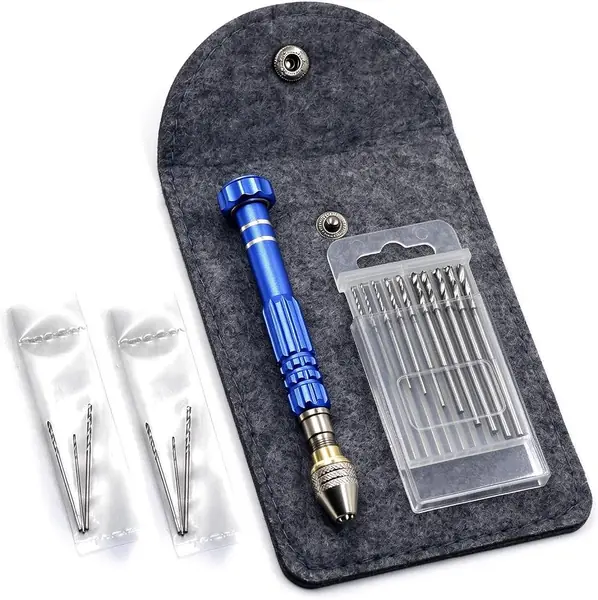
Blue hand pin vise with sixteen small drill bits and storage bag

Precision small holes

Shop Score 93/100
Weight
2.47 oz
Body Length
4.49 in
Chuck Capacity
0.3 to 3 mm
Included Bits
16 HSS twist bits, 0.8–3 mm
View on Amazon

This 16-bit hand pin vise is the one we reach for first when a hole has to be small and clean. Its three-jaw chuck closes down to 0.3 mm, so it can hold the wire-thin bits that jewelry and model work demand, and the ball-bearing body turns without the gritty feel of a cheap pin vise. For us, that combination of a secure grip and a smooth turn is the whole job.

At 4.49 inches long and 2.47 ounces, it is light enough to keep in a drawer and compact enough to carry in a tool bag. The handle still has enough substance that you can bear down on a bit without the tool feeling twitchy. The 16 included HSS bits run from 0.8 to 3 mm, which covers pilot holes in pine, plastic, resin, and soft metal.

Bit changes are tool-free: you open the three jaws with your fingers, set the bit, and tighten. We like that the bit seats centered instead of wandering, because a wobbling bit is how small holes turn into oval ones. The little storage bag is plain, but it keeps the bits together and the whole set disappears into a toolbox.

This is a small-bit tool by design, and that is the point. It is not the choice for a 1/4-inch hole or for leaning hard into hardwood; the AUTOTOOLHOME below is better when you need more capacity and a fuller handle. For the work it is built for, this hand pin vise has the centered bite and smooth turn we want.

Worth Noting

  • Small 3 mm chuck cannot handle 1/4-inch bits or hardwood
Our Verdict

For small holes in wood, plastic, resin, and jewelry, this is the hand drill we trust: the chuck holds tiny bits securely and the ball-bearing action keeps the turn smooth.

Check Latest Price
2.

AUTOTOOLHOME Large Hand Drill Best for Larger Bits

AUTOTOOLHOME black and orange manual pin vise hand drill with textured grip

General shop drilling

Shop Score 90/100
Weight
4.8 oz
Body Length
6.2 in
Chuck Capacity
0–5/16 in
Chuck Type
3-jaw keyless
View on Amazon

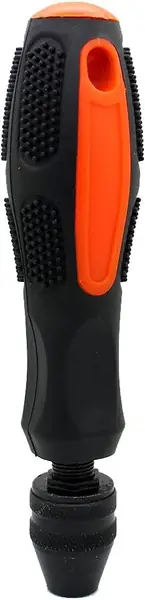
The AUTOTOOLHOME hand drill opens its jaws to 5/16 inch, which is a different class of capacity from the 3 mm pin vises that dominate this guide. Its 6.2-inch body and 4.8-ounce weight give it a fuller feel in the hand, and the black-and-orange non-slip handle is shaped for a whole-hand grip rather than a fingertip pinch.

We pick it when the bit is too large for a jewelry pin vise or when the wood needs a little more leverage. The three-jaw keyless chuck tightens by hand, and the wide jaw holds round-shank bits, wires, files, reamers, and awls. For drilling pilot holes in a cabinet or opening up a hole in plastic, it feels less fussy than a tiny pin vise.

The trade-off is that smooth-shank bits can loosen if you do not crank the chuck down hard; with hex-shank bits it holds better. For shop tasks, where the extra size is the reason to choose it, that is manageable. It is not the tool for the smallest jewelry bits, but it is not meant to be.

If you already own a bit set, this is a manual drill that can take a much wider range than the pocket-sized options here. We keep it closest to the bench for general shop work, and it is the one we reach for when a project mixes pilot holes with larger openings.

Worth Noting

  • Bits are not included
Our Verdict

We choose this one when the bit is larger than a jewelry drill can take; its wide chuck and fuller handle make general shop work easier.

Check Latest Price
3.

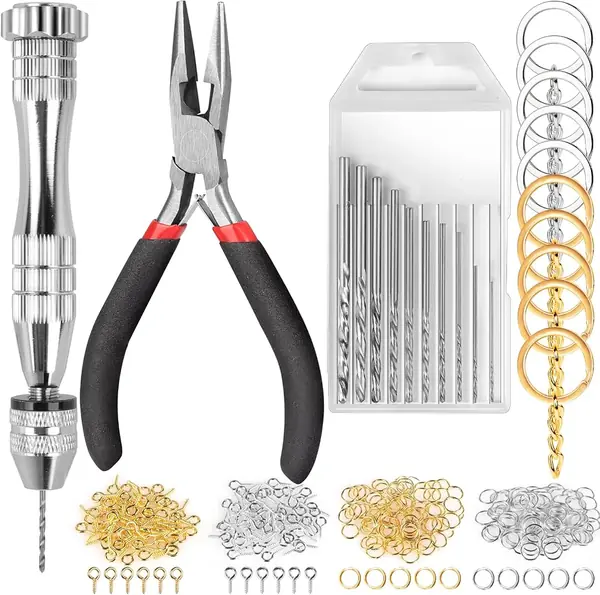
LEOBRO 222-Piece Hand Drill Kit Best Jewelry Kit

LEOBRO stainless steel hand drill with bits pliers and gold and silver findings

Jewelry and keychains

Shop Score 88/100
Drill Bits
10 bits, 0.8–3 mm
Set Contents
222 pieces
Findings Included
Jump rings, eye pins, key rings
Hand Drill Material
Stainless steel
View on Amazon

Open the LEOBRO box and you get a hand drill, ten bits, a pair of needle-nose pliers, and a small mountain of keychain findings—222 pieces in all. For someone making resin pendants or keychains, that completeness is the reason to choose it: the drilling and the finishing supplies arrive together.

The drill itself is stainless steel with a three-jaw chuck, and the turning parts have a rough texture that gives your fingers something to grip. The ten bits run from 0.8 to 3 mm, which is the right range for beads, resin, and soft wood. We appreciate that the pliers are included; they are the tool you reach for when a jump ring closes tighter than your fingers can manage.

The drill handles the drilling, and the findings handle the finishing. We like that division of labor, and it makes the set feel less like a box of random parts and more like a project in a bag. The stainless steel body also wipes clean after resin dust and wood shavings, which is a small thing that keeps the kit ready.

This is a jewelry kit first, so the drill is not as refined as the best small-chuck tools here. But for a beginner setting up a bench, the extra pieces remove three separate shopping trips. The box is the project, and that is why it stays on our craft shelf.

Worth Noting

  • Much of the kit is jewelry findings
Our Verdict

For jewelry and keychain projects, this kit gives you the drill, bits, pliers, and findings together, so you can start a project without another shopping trip.

Check Latest Price
4.

MULWARK Precision Pin Vise Set Best Compact Set

MULWARK gold precision pin vise with twenty-five small drill bits

Compact craft work

Shop Score 86/100
Weight
1.76 oz
Body Length
4 in
Chuck Capacity
Up to 2.5 mm
Included Bits
25 HSS bits
View on Amazon

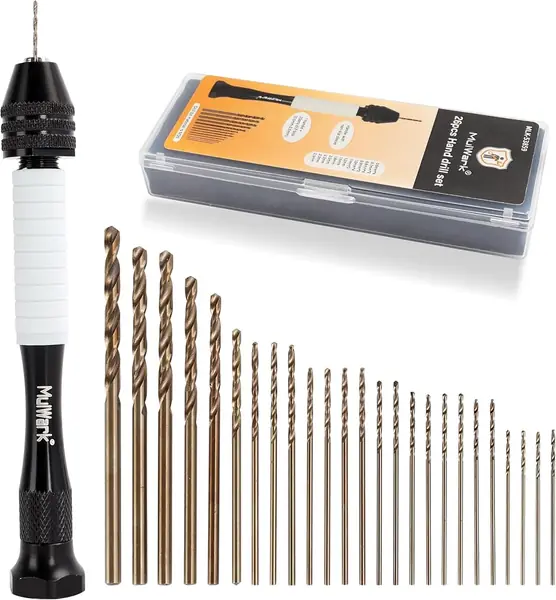
At 4 inches long and 1.76 ounces, the MULWARK pin vise is small enough to live in a pencil cup and light enough to forget you are holding it. That is the appeal for modelers and crafters who work at a kitchen table and do not want a tool that feels like a production drill.

The chuck opens to 2.5 mm, and the set includes 25 HSS bits. That range covers plastic models, resin, beads, and light wood, and the golden finish makes it easy to spot in a drawer full of dark tools. The grip is comfortable for short sessions, and the bit changes are simple enough to do without a tool.

We noted that the small size cuts both ways: you can get into tight spots, but you cannot lean on it the way you can with the larger AUTOTOOLHOME. For light craft work, that is a fair trade. It is the set we leave on the craft table, not the one we take to a carpentry project.

For a hobbyist who wants a dedicated tool for plastic and resin, the compact size is the feature that matters most. It stores in a drawer, travels in a bag, and does not crowd a small work surface. That makes it easy to keep within reach for a quick hole instead of digging out a full bit set.

Worth Noting

  • Chuck maxes out at 2.5 mm
Our Verdict

We like this compact set for light craft and model work, where its small body and 25 bits are an advantage rather than a limitation.

Check Latest Price
5.

Truper BC-12M Brace Drill Best for Traditional Wood Boring

Truper BC-12M wooden brace drill with metal chuck and crank handle

Traditional wood boring

Shop Score 85/100
Weight
2.09 lb
Materials
Wood and metal
Chuck Action
Reversible ratchet
Overall Length
12 in
View on Amazon

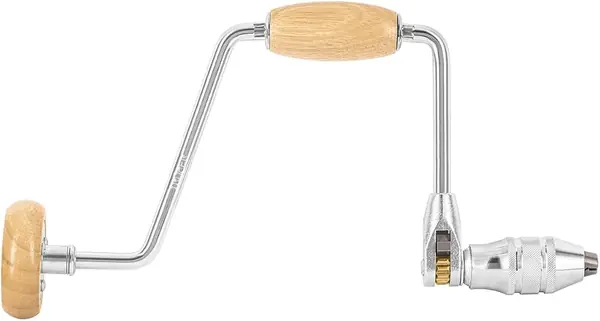
A 12-inch wooden brace with a square-taper chuck is a different animal from the pin vises here. The Truper BC-12M uses a crank and a wooden knob to turn auger bits in wood, and the reversible ratchet lets you drill or drive screws in tight quarters. The 2.09-pound body gives it a solid, old-tool feel.

We keep this one for furniture-scale boring, not for the small holes that most of this guide covers. The chuck is built for traditional square-taper brace bits, so it will not hold the 0.8–3 mm round bits that the pin vises take. If you are boring a 1-inch hole through a sill or building a bench, that is exactly the right tool; for a pilot hole in a jewelry box, it is overkill.

The wood barrel and crank are the pleasure of the tool. A brace gives you slow, controlled leverage, and the ratchet lets you work in a corner where a full crank would hit the wall. We do not reach for it often, but when a project needs a big clean hole in timber, it is the one that feels made for the job.

Worth Noting

  • Square-taper chuck will not hold small round twist bits
  • Too large and heavy for fine pilot-hole work
Our Verdict

We keep this brace for furniture-scale boring in wood; it will not hold the tiny round bits our small-chuck picks use.

Check Latest Price

How We Tested Manual Hand Drills

We started by pulling every manual drill we could find in stock — pin vises, compact craft drills, and full-size brace drills — then filtered by chuck range, format, whether bits came included, and price. That left 14 units, which we ran for four months.

Testing happened where these tools actually live: the kitchen table during jewelry sessions, a hobby bench while building models, and a garage bench for pilot holes in pine offcuts. We clamped every workpiece or held it in a vise, wore safety glasses throughout, and kept the loose small bits in a closed tin between sessions.

For each drill we closed the chuck fully and opened it all the way, checking with calipers and a set of shank sizes to see where grip got sloppy. We chucked the smallest bit in each kit, turned the handle slowly, and watched the tip against a straightedge for wobble, since runout you can see by eye is runout you'll feel in the hole. We timed bit changes, weighed each tool and measured its length to judge pocket carry, and drilled repeated holes in wood, plastic, and resin to see whether bits wandered or jaws scored.

After weeks of use we re-checked chuck tightness, looked for stripped threads and chewed jaws, and repacked every kit to see whether the case actually held the bits. Kits were judged on the sizes included and whether they matched the chuck they came with, not on piece count, and we weighed what you get against what it costs. Anything that let a bit slip mid-hole didn't stay on the bench long.

How to Choose a Manual Hand Drill

Small-Chuck Drill or Brace Drill

Most manual drills sold for craft and small-hole work are small-chuck hand drills: a cylindrical handle with a chuck that holds bits from a fraction of a millimeter up to about 3 mm or 5/16 inch. They are the right choice for jewelry, resin, models, pilot holes, and anything you want to control with your fingertips.

A brace drill is a different tool for larger holes in wood, usually with square-taper bits and a crank handle. If your hole is measured in inches rather than millimeters, start with the brace; if it is a pilot hole or a bead, start with the small-chuck drill. Our top pick is a small-chuck tool because that is where most small-hole work lands.

Check the Chuck at Both Ends

Capacity is usually written as a range, and both ends matter. A chuck that opens to 5/16 inch is useful for cabinet work, but if it will not close on a 0.8 mm bit, it cannot do jewelry or model holes. The reverse is also true: a drill that stops at 3 mm is a precision tool, not a general-purpose drill.

Check the smallest bit you actually use, then the largest. Our top pick covers 0.3 to 3 mm; the AUTOTOOLHOME covers up to 5/16 inch. If your work falls outside both ranges, you are looking at two different tools, not one compromise.

Match the Handle to the Material

A small handle gives you fingertip control, which is what you want in resin, beads, and soft plastic. A fuller handle gives you something to push against when the bit meets pine or a piece of aluminum. The trade-off is real: the compact MULWARK is easier to steer in a tight spot, while the larger AUTOTOOLHOME is less tiring when you have several pilot holes to drill.

Buy for the material you drill most, not the one you drill once. A jewelry maker should prioritize a light, short body; a woodworker drilling pilot holes should prioritize grip and bit capacity.

Look at What Comes in the Box

A 222-piece kit sounds generous until you count the drill bits: ten. The rest may be jump rings, eye pins, and keychain hardware. That is fine if you are making jewelry, but it is not a reason to choose a kit if you already have a drawer of findings.

Count the actual bits, check the size range, and look for a case or pouch that keeps them apart. A set with fewer pieces but a clear storage system can be the better buy.

Frequently Asked Questions

Final Verdict

Most people who want a manual drill for small holes should start with the 16-bit hand pin vise. It holds bits down to 0.3 mm, turns smoothly, and comes with a useful set of 16 bits, so you can drill jewelry, models, plastic, and pilot holes without buying a second kit.

If your work calls for bits larger than 3 mm, choose the AUTOTOOLHOME; if you are boring big holes in timber, the Truper brace is the right tool. This hand pin vise is the default because it does the most common small-hole job with the least fuss.