↑↓ navigate ↵ open Esc close All results →

Best Hand Saws for Cutting Plywood Cleanly of 2026

Grabbing the wrong hand saw for plywood shows up on the very first stroke: too few teeth blow out the face veneer in splinters, too short a blade forces choppy half-strokes, and a flimsy plate pinches halfway across a sheet. Matching tooth count and grind to the veneer, with enough length and stiffness to track straight across a four-foot panel, prevents all three.

Testing 12 saws spanning 9.5- to 20-inch blades over three months on 3/4-inch sheathing, cabinet-grade veneer panels, and full sheets on sawhorses separated crisp trackers from wandering plates. Handle balance also shifts from an afterthought to a real factor by the twentieth cut of an afternoon, while impulse-hardened teeth stay sharp longer at the trade-off of needing a replaceable blade rather than a file.

Whether the job calls for breaking down full sheets, trimming clean veneer edges, or knocking out fast rough cuts and weekend repairs, each saw below leaves a kerf clean enough to skip extra sanding.

Our Top Picks

The Best Hand Saws for Cutting Plywood Cleanly

1.

Craftsman 20-Inch Fine Finish Hand Saw Best Overall
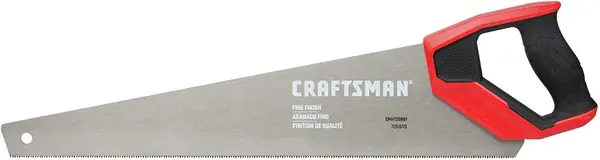
Craftsman 20-inch fine finish hand saw with steel blade and composite handle

Full-sheet crosscuts

Shop Score 94/100
Blade Length
20 inches
Teeth
Induction hardened
Weight
14.4 oz
Handle
45- and 90-degree miter marks
View on Amazon

A 20-inch blade is the traditional size for sheet goods, and using this one explains why: there's enough steel in the stroke to keep the saw running on the line while you work across a four-foot panel. At 14.4 ounces it doesn't wear you out, and the high-speed steel blade is stiff enough that it doesn't wander when you come into a cut at a shallow angle.

The fine-finish tooth line is why this is our overall pick over the fast coarse-cut saws. Plywood is a thin face veneer over soft core plies, and a fine, hardened tooth pattern severs that face instead of lifting it, so the cut comes off the saw with far less fuzz. The composite handle has 45- and 90-degree angles molded into it, and we found ourselves using them to mark around a corner when the square was buried under the sheet.

Nothing here is delicate. Beside the pull saws in this guide it's the heavier, more deliberate tool — you push through the cut rather than draw the teeth through it, and a long rip will remind you of that. What you get in return is coverage: this is the saw sized for a whole sheet rather than for trim, and it's one of the least expensive picks here.

Worth Noting

  • Hardened teeth cannot be resharpened
Our Verdict

It's the saw we tell most people to buy for plywood: a 20-inch fine-tooth blade that crosses a sheet and leaves an edge you can work with.

Check Latest Price
2.

Kerye Japanese Pull Saw 9.5-Inch Best for Clean Edges

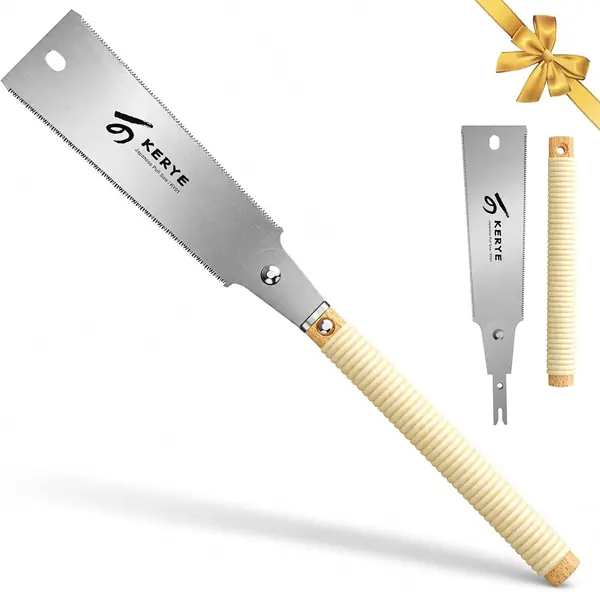
Kerye Japanese pull saw with light yellow beechwood handle and thin double-edge blade

Clean veneer edges

Shop Score 93/100
Blade Length
9.5 inches
Teeth
10 and 17 TPI double edge
Weight
9.6 oz
Blade Thickness
0.02 inch
View on Amazon

Plywood gives up its face veneer easily, and the Kerye's 0.02-inch blade is the reason this is the saw we hand over when the edge has to look finished. Its 17 TPI crosscut side slices the veneer rather than lifting it, the kerf is narrow enough that a cut in 3/4-inch stock feels close to effortless, and because the teeth cut on the pull stroke the thin blade stays under tension instead of bowing. The edges we got needed a light pass with a sanding block and nothing more.

The second edge is a 10 TPI rip pattern, coarse enough to move down a strip in a hurry and handy for a vent cutout or a sink opening that doesn't run edge to edge. Blades are replaceable: loosen the handle with the wrench that comes with it, fit a new SK5 blade, and the saw is back in service. At 9.6 ounces with a beechwood handle, it's light enough to run one-handed on a cut above shoulder height.

Nine and a half inches is trim-saw length, not panel-saw length. Across a full sheet you'll want the cut line clamped and you'll be resetting your stance partway through, which is exactly the job the Craftsman handles in a single run. Treat this one as the second saw in the shop — the Japanese pull saw that makes an edge worth showing — and the pair covers everything from breaking down a sheet to fitting a shelf.

Worth Noting

  • Thin blade can kink if the stroke twists
Our Verdict

If the cut edge is going to show, this is the saw we reach for: a 0.02-inch blade with 17 TPI crosscut teeth that leave plywood nearly ready to finish.

Check Latest Price
3.

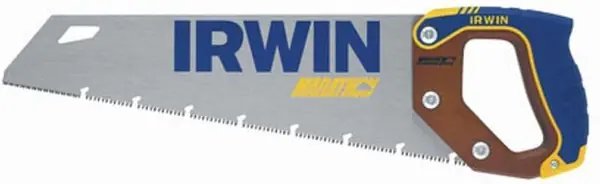
Irwin 15-Inch Coarse Cut Hand Saw Best for Fast Rough Cuts

Irwin ProTouch 15-inch coarse cut hand saw with cushioned grip handle

Sheathing and subfloor

Shop Score 92/100
Blade Length
15 inches
Weight
16 oz
Handle
ProTouch cushioned grip
Cut
Coarse cut
View on Amazon

Coarse teeth and deep gullets are built for speed, and that's what this Irwin delivers: the teeth throw chips clear instead of dragging them back through the kerf, so the blade keeps moving even in thick stock. The thick-body blade does the rest — it stays rigid through a long cut instead of whipping, which matters when you're cutting something structural and can't afford a line that wanders.

Fifteen inches is a toolbox length rather than a panel length. That's an advantage on a ladder or in a tight corner, and less of one across a four-foot sheet, where a longer saw covers the distance in fewer strokes. The ProTouch grip is the detail we appreciated most: it's shaped and cushioned, and after a run of cuts through 3/4-inch ply it left our hand fresher than we expected.

It's the saw for subfloor, sheathing, and a quick breakdown of construction-grade ply — the work where speed is the whole point and the cut is going to be covered by something else. On a morning of cutting, it's the one that saves us the most time, and the thick blade means you're not fighting the saw to hold a line.

Worth Noting

  • Coarse teeth leave a rough edge on veneered plywood
Our Verdict

Our fast-cut pick for sheathing and subfloor: a stiff 15-inch blade with coarse teeth that clear chips and keep the saw moving.

Check Latest Price
4.

Jorgensen 10-Inch Double Edge Pull Saw Best for Rip and Crosscut

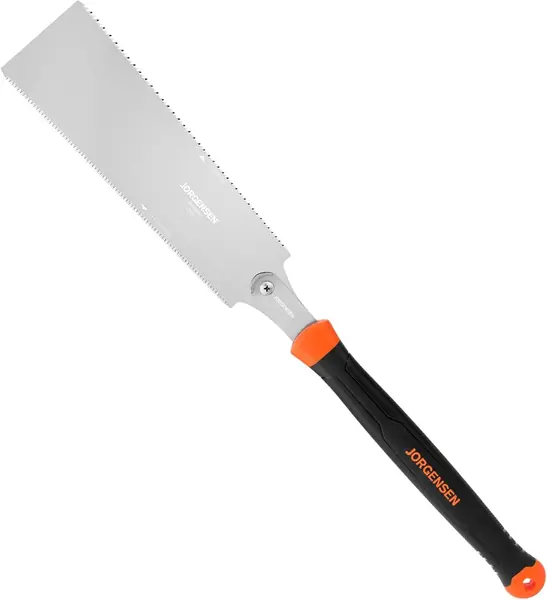
Jorgensen 10-inch double edge Japanese pull saw with soft-grip plastic handle

Rip and crosscut

Shop Score 91/100
Blade Length
10 inches
Teeth
7-12 and 18 TPI edges
Handle
Non-slip soft grip
Blade
Replaceable SK5 steel
View on Amazon

Set this Jorgensen beside the Kerye and the family resemblance is plain: two double-edged pull saws with replaceable SK5 blades and the same job description. The differences decide it. The Jorgensen runs a 10-inch blade, its crosscut edge is 18 TPI against the Kerye's 17, and the handle is a soft-grip composite rather than beechwood.

Where it wins us over is the second edge. The rip side carries a progressive 7-to-12 TPI pattern, so it bites in a thin panel and still has teeth left for deeper cuts — the reason this is the pull saw we keep for a strip that has to come off a sheet. The composite handle is the quieter advantage: it doesn't mind a damp toolbox or a work glove, and it wipes clean.

What it doesn't do is break down a whole sheet. At 10 inches it's a trim and cutout saw, so plan on a clamped straightedge and a reset or two to cross anything wide. Keep the strokes long and light and let the teeth work; forcing a blade this thin is how you shorten its life.

Worth Noting

  • 10-inch blade cannot break down full plywood sheets
  • Thin blade risks damage if forced through cuts
Our Verdict

We like it as the one pull saw for both jobs: an 18 TPI edge for clean plywood crosscuts and a progressive rip side for taking strips off a sheet.

Check Latest Price
5.

QYQRQF 14-Inch Pro Hand Saw Best for Occasional Light Work

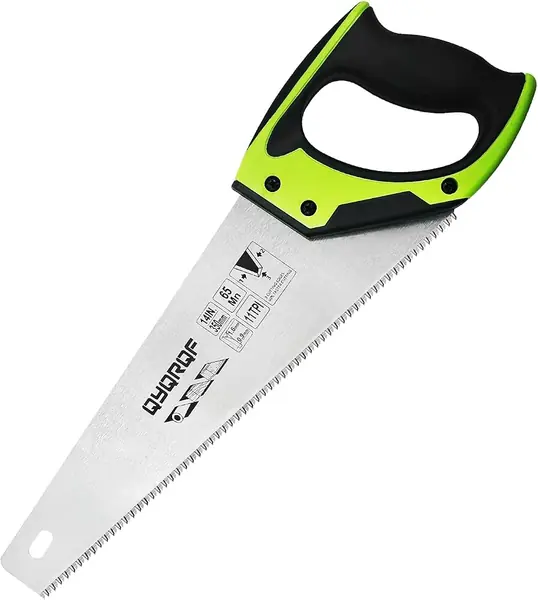
QYQRQF 14-inch green hand saw with non-slip rubber handle and blade guard

Occasional light work

Shop Score 89/100
Blade Length
14 inches
Teeth
11 TPI three-face grind
Weight
12.1 oz
Blade Thickness
0.9 mm
View on Amazon

It's the least expensive saw here, and the spec sheet is more convincing than the price tag: a 14-inch blade in heat-treated 65Mn steel, 11 TPI with a three-face grind, a low-friction coating, and a rubberized handle. It ships with a plastic guard over the teeth and a paper sleeve on the blade, so it can live in a toolbox without chewing up everything around it.

Where it has earned its keep for us is the work that isn't cabinetmaking. It's the saw that goes out to the garden, cuts a length of PVC pipe, trims a scrap of plywood into a shim, or opens a cutout in a panel headed for the back of a closet. At 12.1 ounces it carries easily, and the non-slip handle holds on when your hands are damp.

For furniture-grade plywood, the Craftsman or the Kerye is the better tool — that's not the job this one is applying for. What it buys is a saw in the truck, in the shed, in the camping bin, the one you don't mind lending out. That's a real role, and it's why it stayed on this list.

Worth Noting

  • Sharpness varies from saw to saw
  • Aggressive teeth make starting a cut hard
Our Verdict

We think of it as the spare: light, inexpensive, and fine for trimming, PVC, and the odd plywood cutout.

Check Latest Price

How We Tested Hand Saws on Plywood

We started with the specs that actually change a plywood cut: tooth count and grind, blade length, kerf thickness, and whether the teeth were hardened or the blade could be replaced. From there we narrowed to 12 saws spanning 9.5- to 20-inch blades, dropping anything that duplicated another saw's size-and-tooth combination, and made sure the shortlist included both Western push saws and Japanese pull saws.

For three months those saws lived in the garage and the driveway, mostly on weekends. Every cut started the same way: the sheet supported on rigid foam scraps on both sides of the line so the kerf couldn't close, a straightedge clamped down rather than held by hand beside the cut, and the hand steadying the off-cut kept well clear while we eased off on the last strokes. We noted whether each saw skated or bit on its first stroke into veneered plywood, how far a single stroke traveled across a four-foot crosscut, and how straight the blade tracked when we fed it into the line at a slight angle.

We ran batches of 20 cuts per saw and asked whoever was holding it to rate balance and handle comfort at the end of each batch, then weighed every saw to check the numbers against the feel. After three months we compared a fresh cut to our first cut on the same panel to judge how much the teeth had dulled, and noted which blades could be swapped or resharpened and which were finished. Sturdiness got the same treatment — we watched for handle flex and blade whip under side load — and we set each saw's price against the rest of the set before deciding what made the list.

How to Choose a Hand Saw for Plywood

Tooth count decides whether the face survives

Coarse teeth — seven to nine points per inch — clear chips fast, which is why framing saws are built that way, and they lift the face veneer as they exit. A fine crosscut line of ten points or more severs the veneer instead. The trap is buying a fast coarse-cut saw for cabinet-grade plywood because it feels aggressive in the store, and the second trap is assuming more teeth is always better, since a very fine saw bogs down in a long rip.

Match the tooth to the panel: coarse for sheathing and subfloor, fine for anything that will be seen. The Japanese pull saws here run 17 to 18 TPI on their crosscut side, our Craftsman pick carries a fine-finish tooth line, and the Irwin is the coarse option.

Blade length sets how far you go in one stroke

A 20-inch blade is the traditional panel-saw size because it gives a full, controlled stroke across a sheet without your arm running out of travel, and that's what our top pick carries. Fourteen or fifteen inches is a toolbox length: fine for shelf crosscuts, cutouts, and tight corners, but you take more strokes and have more chances to drift on a four-foot cut. Pull saws at 9.5 to 10 inches are trim tools.

None of that makes a short saw bad — it makes it a second saw. If you buy one, buy the length that matches the biggest cut you actually make.

Stiffness, kerf, and how the saw tracks a line

Rigid blades hold a line with less help from you, which is why thick-body panel saws are the choice for a long straight cut without a clamped guide. Thin blades remove less material per stroke and cut faster with less effort — the Kerye's is 0.02 inch — but they follow your hand rather than correcting it, and a twist can kink one.

The trap is assuming thin and fast always wins. For a full-sheet rip, stiffness is what keeps the kerf straight; save the thin blade for edges and cutouts.

What happens when the blade goes dull

Hardpoint teeth are hardened to stay sharp a long time and cannot be filed, so when a panel saw like the Craftsman or the Irwin dulls, the saw is finished. Pull saws with replaceable blades, like the Kerye and the Jorgensen, take a fresh blade in about a minute with the wrench that ships with them.

If you cut plywood most weekends, the replaceable blade is worth the higher upfront cost; if you cut a sheet or two a year, a hardpoint saw is the sensible spend.

Frequently Asked Questions

Final Verdict

We recommend the Craftsman 20-inch fine-finish saw as the default. It's the one saw here sized for a whole sheet, with a fine tooth line that keeps the veneer intact and 45- and 90-degree marks molded into the handle, and it costs less than most of the alternatives.

If the plywood edges are going to be seen, add the Kerye Japanese pull saw. Its thin blade leaves the cleanest edge in this group and reaches the cutouts a panel saw can't, which makes the two together a complete hand-tool setup for sheet goods.