↑↓ navigate ↵ open Esc close All results →

Best Rail and Stile Router Bits for Cabinet Doors of 2026

What separates a dependable rail-and-stile bit set from a frustrating one is whether its cope, stick, and panel groove agree within a few thousandths of an inch. A matched pair lets a cabinet door frame press together cleanly by hand, whereas slight machining mismatches leave a hairline gap showing daylight, a rail sitting proud of the stile, or a center panel that rattles.

Routing shaker and raised-panel doors in oak, maple, and MDF across 12 bit sets over eight months on a table-mounted router highlighted one reality that catches many builders off guard: nominal plywood panels rarely match their printed thickness. Sets with shim-adjustable groove cutters adjust cleanly to undersized sheet goods, saving far more rework than decorative profile variations.

Half-inch shanks belong on any structural door stock, leaving quarter-inch cutters strictly for light frames and shallow passes. Evaluated on stock capacity, ease of shimming, and carbide edge retention in oak, these seven matched sets belong in a working cabinet shop.

Our Top Picks

The Best Rail and Stile Router Bits for Cabinet Doors

1.

Freud 99-762 Premier Adjustable Rail & Stile Bit Set Best Overall
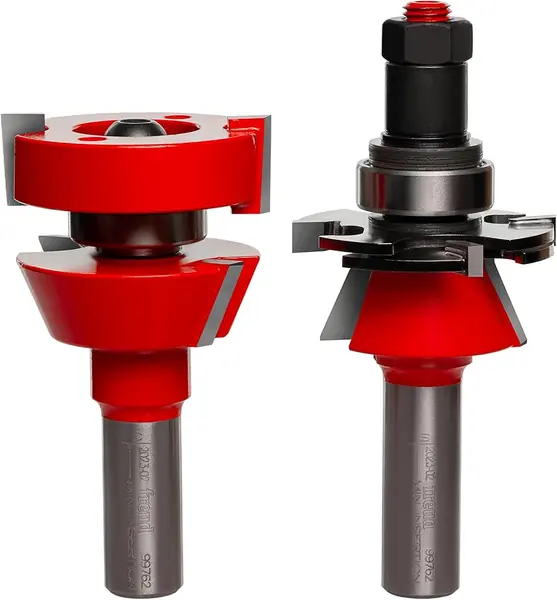
Freud 99-762 adjustable rail and stile router bit set with 1/2-inch shanks and carbide cutters

Mixed stock thicknesses

Shop Score 91/100
Shank
1/2 inch
Cutter Diameter
1-11/16 inch
Stock Thickness
5/8 to 1-1/4 inch
Panel Groove Range
7/32 to 3/8 inch
View on Amazon

Doors from 5/8 inch to 1-1/4 inch thick, one set, no second purchase. That range is why the Freud 99-762 is the set we tell people to buy first: a cabinet door is usually built from 3/4-inch stock, but the job that follows it — a pantry door, a window seat, a piece of furniture — often is not, and a fixed-depth set is finished the moment the stock changes. The shims set the panel groove anywhere from 7/32 inch to 3/8 inch, so the same pair cuts a groove for thin plywood and for a solid wood raised panel.

What we watch on a rail and stile set is the rail end, where the cope cutter meets end grain and where a dull or badly supported bit shows up as tearout you cannot sand out. Freud's extended tenon leaves more long grain in the joint than a short tenon, and the carbide stays clean through oak and maple with the coating keeping pitch from building on the body. We still run a backer board on the rail, but on this set it feels like insurance rather than a requirement.

Setup is the part we slow down for. The shim stack is simple in principle — add or remove to change the groove width and the tongue fit — but the printed instructions are thin and there is no setup chart in the box. Count shims on a labeled offcut before any door stock goes near the table, and keep that offcut; the second joint is a great deal easier than the first.

Against the Yonico 12249 below, the Freud costs a good deal more, and a shop that builds nothing but 3/4-inch shaker doors will do fine with the cheaper pair. What the extra money buys is range: one set that follows the work rather than a set for every thickness.

Worth Noting

  • Premium price against the shaker sets here
Our Verdict

We hand the Freud 99-762 to anyone who asks which set to buy: the shims fit the groove and tenon to your stock, so one purchase covers doors from 5/8 inch to 1-1/4 inch.

Check Latest Price
2.

Yonico 12249 Shaker Rail and Stile Router Bit Set Best Everyday Shaker Set

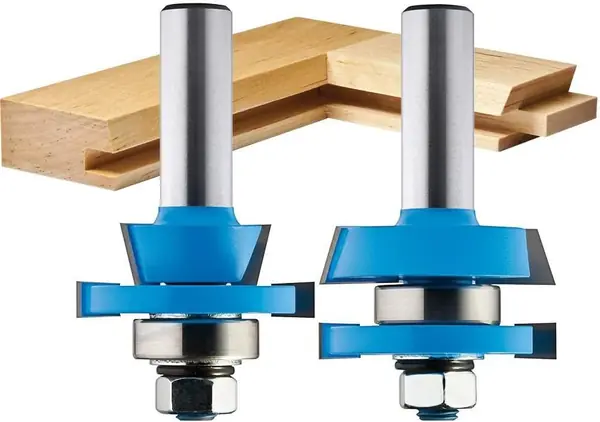
Yonico 12249 shaker rail and stile router bit pair with 1/2-inch shanks in a wooden case

Standard shaker doors

Shop Score 90/100
Shank
1/2 inch
Stock Capacity
Up to 7/8 inch
Included
2 bits in a wooden case
Cutting Depth
3/8 inch
View on Amazon

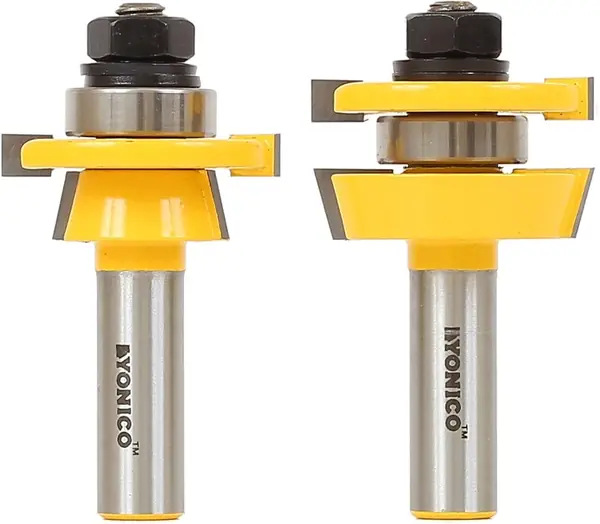
Two bits, a wooden case, and a 3/8-inch cut in stock up to 7/8 inch: that is the whole offer of the Yonico 12249, and for a shaker door in standard cabinet stock it covers the job.

Both cutters run on a 1/2-inch shank, which is the first thing we check on a set headed for oak — the extra mass damps vibration, and vibration is what turns a cope cut into a washboard. The profile is the plain shaker step, so the rail meets the stile flush and the panel sits in a 3/8-inch-deep groove. This is a table-mounted bit; a router table with a fence and a backer board is where it belongs.

Where the set shows its limits is dense stock over a long run. In pine, poplar and MDF it keeps cutting through a batch of doors, and the joint stays tight enough that clamps do the work rather than force. On oak and hard maple the rail cutter is the one that tells on itself: burning on long rails and an edge that gives up sooner than we want. If your doors are paint-grade, this is the shaker set we point to first; if they are stained white oak, budget for a spare cutter or step up.

Worth Noting

  • Rail cutter burns and dulls on hard stock
  • May need shimming to tighten the tongue fit
Our Verdict

Our pick for ordinary 3/4-inch shaker doors — a matched pair on 1/2-inch shanks in a wooden case, as long as your stock is softwood, poplar, or MDF.

Check Latest Price
3.

Whiteside 6009 15-Degree Shaker Stile and Rail Bit Best 15-Degree Shaker Profile

Whiteside 6009 15-degree shaker stile and rail bit set with 1/2-inch shank

15-degree shaker doors

Shop Score 89/100
Shank
1/2 inch
Stock Capacity
Up to 3/4 inch
Cutter Diameter
1-5/8 inch
Tongue Depth
3/8 inch
View on Amazon

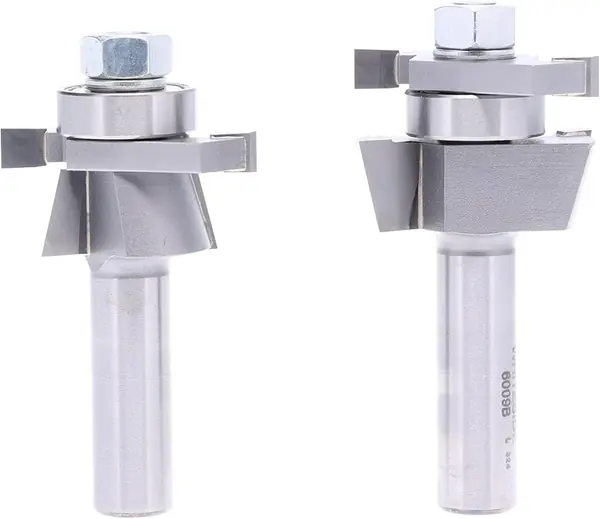
A 15-degree bevel is a small change to a shaker door and the one we notice every time we open a cabinet. Instead of the stepped edge most shaker sets cut, the Whiteside 6009 lays a flat chamfer around the frame, and on a finished door it reads cleaner and more modern — a sharper shadow line and less edge to snag a dust cloth. If the door style is already settled, this is the set that gets it right.

It is a matched two-bit pair for 3/4-inch material, with a 3/8-inch tongue depth and a 1-5/8-inch cutting diameter on 1/2-inch shanks. The diameter matters: there is enough cutter head there to take a steady pass without the bit wandering, and the mass helps in a table router. The groove is cut for a true 1/4-inch panel, so measure your panel stock before you build — nominal 1/4-inch plywood usually comes in under that and will rattle in a groove cut to the full quarter inch.

Changing the groover cutter or the tongue cutter changes what the set will do, which is more flexibility than a fixed pair offers. Prove the joint on scrap before you commit door stock: height and depth both have to be right, and fitting the pair takes a test corner or two.

Worth Noting

  • Premium price for a two-bit set
Our Verdict

Buy this one for the profile: a 15-degree bevel makes a sharper, more modern shaker door than the stepped edge most sets cut.

Check Latest Price
4.

Yonico 12335 Ogee Raised Panel Door Bit Set Best Raised-Panel Set

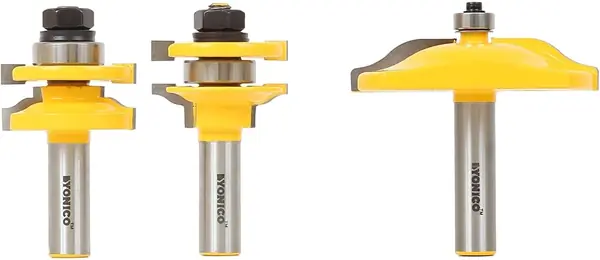
Yonico 12335 three-piece ogee rail and stile set with raised panel bit in wood case

Raised-panel ogee doors

Shop Score 88/100
Shank
1/2 inch
Stock Capacity
Up to 1 inch
Included
3 bits and a wooden case
Profiles
Ogee rail and stile plus raised panel
View on Amazon

The third bit is the reason to look at this set at all. The Yonico 12335 ships the ogee rail bit, the matching stile bit and a raised panel cutter in one wooden case, so a door that would otherwise take two purchases comes out of a single box: frame and center panel together.

The rail and stile pair cuts the ogee frame in stock up to 1 inch, and the panel raiser puts the classic ogee shoulder on the center panel that floats inside it. Enclosed bearings guide the cuts, the shanks are 1/2 inch, and the three bits arrive in a solid wood storage case with an Allen wrench and extra spacers.

The panel cutter is a large-diameter bit, and the maker is blunt about it: this set belongs in a table-mounted router only. We agree — a cutter that size in a handheld base is asking for trouble. On hard woods the ogee cutter gives up its edge sooner than the price suggests; oak and hard maple will tell you when it is time to sharpen, while paint-grade poplar and MDF run all day.

Where we land: this is the set for the woodworker building a raised-panel kitchen who wants the whole door covered without buying a panel raiser separately. If your doors are flat shaker, buy the 12249 and save the panel bit for a job that needs one.

Worth Noting

  • Dulls quickly on hard woods
  • Requires a table-mounted router for the panel cutter
Our Verdict

A complete ogee door in one box, panel raiser included; we recommend it to anyone building raised-panel cabinets rather than flat shaker ones.

Check Latest Price
5.

WSOOX 1/2-Inch Shank Ogee Rail and Stile Bit Set Best Budget Three-Bit Set

WSOOX three-piece 1/2-inch shank ogee rail and stile bit set with panel raiser

First-time door builders

Shop Score 87/100
Shank
1/2 inch
Stock Capacity
Up to 1 inch
Included
3 bits
Cutting Depth
3/8 inch
View on Amazon

Three 1/2-inch-shank bits — tongue, groove and raised panel — with an ogee frame profile and a 3/8-inch cut in stock up to 1 inch. That is the same job list as the premium sets here, and at this end of the market the shank size is usually the first thing that gets cheapened, so finding 1/2-inch steel on all three cutters is the detail we noticed. The shanks fit standard benchtop router tables, and a set this size wants one.

YG6 carbide blades on hardened carbon steel bodies, a heat-resistant coating to shed pitch, anti-kickback geometry and enclosed bearing rollers fill out the package. For a first set of doors, a run of shop cabinets or a one-off window seat, this is where we put the budget: the money goes into three usable cutters instead of a case and a brand name. Long-run edge life is the open question, so treat it as the set for this project rather than for the next ten kitchens.

Worth Noting

  • Requires a router table and ships without a storage case
  • Long-run edge life suits single projects rather than heavy production
Our Verdict

When the budget sets the ceiling, this is the set we point to: three 1/2-inch-shank bits that cover a complete ogee door.

Check Latest Price
6.

Rockler Shaker Rail and Stile Router Bit Set Best for Chamfered Shaker Doors

Rockler two-piece shaker rail and stile router bit set with 1/2-inch shanks

Chamfered shaker doors

Shop Score 86/100
Shank
1/2 inch
Bits Included
2 matched rail and stile bits
Router
Table-mounted at reduced RPM
Profile
Chamfered shaker
View on Amazon

Cope cuts first, while the rail ends are still square and backed up — that is the order Rockler prints with this set, and it is the right one. The same guidance covers the backer board behind the rail, keeping the bit off the bottom of the collet, and running a table-mounted router at reduced RPM. That is more setup help than most sets here come with, and for a first door it is worth real money.

The profile is the other draw: a chamfered edge rather than a stepped or rounded shaker frame, cut by a matched bearing-guided pair on 1/2-inch shanks. On the finished door it is the shaker look most people are picturing — a small flat bevel, a clean shadow line, nothing fussy. We like this pair a great deal; we just do not think it is the set to buy if you have not settled on the profile yet.

It is the most expensive set here, and that money buys one door style rather than range. If your router lives in a table and every door in the house will wear this chamfered shaker edge, the cost is easy to justify. If you are still trying profiles, the adjustable Freud or the Yonico shaker pair will take you further for less.

Worth Noting

  • Highest price in this group
  • Table-mounted use at reduced RPM only
Our Verdict

We recommend the Rockler pair to woodworkers who have settled on the chamfered shaker look and want instructions that get the first door right.

Check Latest Price
7.

Junreox 2-Piece Tongue and Groove Router Bit Set Best for Light-Duty Shaker Doors

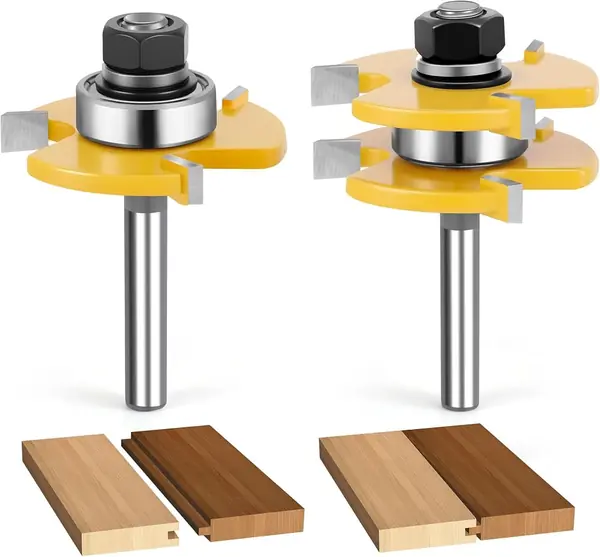
Junreox two-piece tongue and groove router bit set with 1/4-inch shanks

Light-duty shaker doors

Shop Score 85/100
Shank
1/4 inch
Bits Included
2
Cut Depth
1/2 inch
Stock Range
0.51 to 0.74 inch
View on Amazon

A 1/4-inch shank settles this one before you look at anything else. If your router only takes 1/4-inch bits — a trim router, a small table, an older plunge base — the Junreox pair is the least expensive way here to cut a shaker door joint, and none of the other sets on this page will fit that collet.

It is a tongue-and-groove pair rather than a coped set: a 1/4-inch-wide tongue, 1/2 inch deep, in boards up to about 3/4 inch thick, with three teeth and hardened bodies. That tongue is narrower than the deep tenons the better sets cut, which matters more on a wide door than a small one; for a vanity or a run of shop cabinets it is plenty of glue surface.

Read the maker's own warning, because it is the honest one: clamp at least two thirds of the shank, keep the router level and take light passes. A quarter-inch shaft will flex if you lean on it, and a bent bit spinning in a router is not a small problem. Used inside that limit — light passes, small doors, softwood or MDF — this is a lot of joint for the money and a sensible place to start.

Worth Noting

  • Cuts only about 1/2 to 3/4 inch stock
  • Flat-face joints only, without a coped rail
Our Verdict

Buy it if 1/4-inch is the only collet you own; we think it is the sensible first set for small doors, light passes, and softwood.

Check Latest Price

How We Tested These Rail and Stile Router Bits

We started with a few dozen sets and narrowed them to 12 on paper, comparing stock capacity, shank diameter, bit count, and whether the maker publishes a setup chart and an RPM limit. Sets that arrived with no setup documentation or no table-mount guidance didn't make the cut. Every bit was seated two-thirds of the way into the collet, never bottomed against it, and run in a table-mounted router only — the large raised-panel cutters especially.

Over eight months we built doors: a run of shaker doors for a kitchen refresh, a raised-panel ogee door for a built-in, and a stack of small doors for a bathroom vanity, in red oak, maple, and MDF. Every rail cut got a backer board so we were judging tearout rather than luck. We dry-assembled each joint, held it to a light, and noted whether it closed by hand or needed shims, then put calipers on tongues and panel grooves to see how close they landed to the actual stock. The 1/4-inch set got lighter passes by design, since that shank flexes under a full-depth door cut.

Setup was timed from unboxing to the first accurate cut, and we recorded whether the instructions said which bit went where and what the shims were for. For edge life, we kept a cut log in oak and watched for the feed getting heavy and the cuts starting to burnish. Value came down to what a set let us do without buying a third bit: a groove range wide enough for real plywood, a tongue we could shim, and carbide that still cut cleanly at the end of the eight months.

How to Choose Rail and Stile Router Bits

Start With Your Router's Collet, Not the Price

Door work is heavy cutting: a 3/8-inch-deep groove in hardwood needs a bit that will not deflect. A 1/2-inch shank gives you that mass, which is why every serious set here uses one. A 1/4-inch shank will cut a door, but only in light passes, and the maker of the Junreox pair warns about shank bending in its own instructions — that warning is the honest version of what a small shank costs you.

Check your collet before you shop. If it only takes 1/4 inch, that decides the list for you, and you should plan on lighter passes and smaller doors. If it takes 1/2 inch, buy 1/2 inch and stop thinking about it.

Match the Set to Your Stock Thickness

Standard cabinet doors are built from 3/4-inch stock, and a set rated to 7/8 inch covers that with room for a panel groove. If you might build a thicker door — an exterior door, a piece of furniture, a window seat — buy a set that states the range, either up to 1 inch or adjustable across several thicknesses.

The Freud 99-762 runs from 5/8 inch to 1-1/4 inch on shims; the Yonico 12335 goes to 1 inch. Buying for the thickest door you plan to build is cheaper than buying twice, and it is the reason we put an adjustable set at the top of this list.

The Panel Groove Is Where Doors Go Wrong

Here is the trap. A set that cuts a true 1/4-inch groove mated to nominal 1/4-inch plywood — which usually measures undersized — leaves a panel that rattles, and you end up shimming it and hoping. Check how each set handles panel thickness before you buy, not after the door is glued.

The Freud's shims adjust the groove from 7/32 inch to 3/8 inch, which covers thin plywood at one end and a solid wood raised panel at the other. The Whiteside 6009 is cut for a true 1/4-inch panel and wants panel stock to match. Measure your panel material first and let that decide.

Decide the Door Style Before You Buy Bits

Most cabinet door router bits come as a two-bit frame set: one cutter profiles and grooves the stile, the other copes the rail end to fit over it. A raised-panel door needs a third cutter for the panel edge, which is why the Yonico 12335 and the WSOOX sets come as three pieces with a panel raiser.

Buying the frame bits first and the panel raiser later is a false economy once you know the style, because the profiles have to match and matching across two purchases is harder than buying a matched set.

Setup and Edge Life Are What You Actually Pay For

Cheap bits will cut a door. What separates them over a kitchen's worth of oak is how long the edge lasts and how much help you get dialing the joint in. Look for shims, spacers, or a setup chart in the box, and accept that the first hour belongs to labeled test cuts rather than door stock.

Plan for wear on the cutter that does the most work. On hard maple and white oak the rail or panel cutter usually goes first, so budget for a sharpening or a replacement before the whole set is tired.

Frequently Asked Questions

Final Verdict

The Freud 99-762 is the set we recommend to almost everyone: the shims let you fit the groove and tenon to the stock in front of you, and the 5/8-inch to 1-1/4-inch range means the next door does not require a new purchase.

Build nothing but 3/4-inch shaker doors and the Yonico 12249 does the same work with less fuss and less money. On a first kitchen, or a budget that will not stretch, the WSOOX three-bit set covers a whole ogee door for a fraction of the price — just do not expect the edge life of the Freud.