↑↓ navigate ↵ open Esc close All results →

Best Roundover Router Bits of 2026

A bad roundover pass leaves scorch marks along maple edges that stubbornly refuse to sand out, turning a finished cutting board into shop shelving. When the carbide is sharp and balanced, a roundover bit turns a crisp 90-degree corner into an even curve in a single pass with almost no cleanup afterward.

Running 14 quarter-inch-shank bits through both handheld routers and a router table over six months showed how quickly bearing quality and carbide grind show up in real lumber. Radius sets the profile more than price does—a 1/8-inch round handles everyday shelves and boards while larger radii suit thicker stock—and even slight play in the guide bearing ruins a cut regardless of cutter grade.

Single bits keep costs down for shops that stick to one standard radius, while four- and six-piece sets cover thicker stock profiles without leaving rough transitions to sand smooth.

Our Top Picks

The Best Roundover Router Bits

1.

Freud 34-104 Rounding Over Bit Best Overall
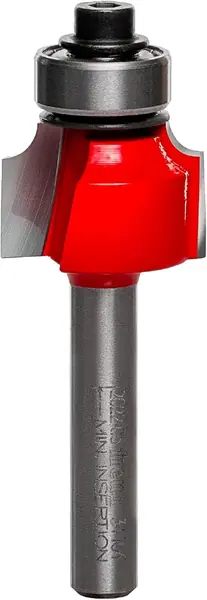
Freud 34-104 roundover router bit with 1/4-inch shank and Perma-Shield coated 1/8-inch radius cutter

Softening sharp edges

Shop Score 94/100
Shank Diameter
1/4 inch
Radius
1/8 inch
Coating
Perma-Shield
Overall Length
2-3/16 inches
View on Amazon

End grain is the honest test of a roundover bit: the cutter leaves the fibers rather than slicing along them, and a bit that isn't sharp and cleanly ground leaves fuzz you have to sand back by hand. This one came off end grain and Baltic birch plywood clean, corners closed, nothing to chase. The Perma-Shield coating plays a part — resin doesn't load the face as quickly, so the cutter keeps cutting instead of rubbing.

It's the bit we reach for first, and the reason it takes Best Overall is the balance of it: a true 1/8-inch edge break, clean cross-grain cutting, and a price that sits below the premium single here without a compromise you can feel in the cut. The 1/4-inch shank drops into a trim router, and at 2-3/16 inches long it stays settled in a palm router instead of chattering through the entry.

The 1/8-inch radius is subtle and, once you've used it, hard to live without: shelves, drawer fronts, small boxes and shop jigs all feel finished rather than raw. Freud sells this as a rounding over bit, which is the honest description of the job. Fit a bearing 1/8 inch smaller in diameter and the same cutter produces a beading profile — a second bit for the price of a bearing. It also runs happily in a table, which is how we use it on long stock.

Worth Noting

  • Only a light 1/8-inch edge break
Our Verdict

We recommend the Freud 34-104 as the default roundover bit: clean cuts on end grain, a usable 1/8-inch edge break, and a second profile from a bearing swap.

Check Latest Price
2.

Whiteside 2000C Roundover Bit Best Cut Quality

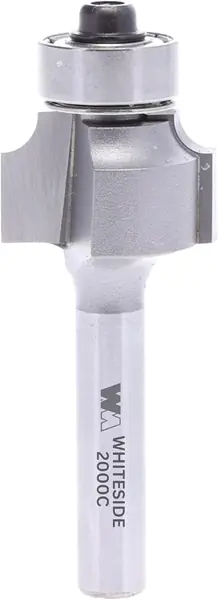
Whiteside 2000C carbide-tipped roundover router bit with 1/4-inch shank and 3/4-inch cutting diameter

Fine finish work

Shop Score 93/100
Shank Diameter
1/4 inch
Radius
1/8 inch
Cutting Length
1/2 inch
Large Diameter
3/4 inch
View on Amazon

Hard maple is unforgiving — any dullness or imbalance shows up immediately as tearout across the grain, and this bit produced none. The surface came off the cutter ready for finish, the cleanest cut of the single bits here, with the profile staying crisp through a long run of edging. That, more than any specification, is the case for it.

Credit the geometry and the mass behind it. The 3/4-inch large diameter puts more steel behind the cut than the smaller bits in this group, and the solid steel shank holds the cutter rigid with reduced vibration. We noticed the difference in a palm router, where the bit stayed settled through a full edge rather than chattering at the start of the pass. It's carbide-tipped rather than solid carbide, which is how a bit of this size stays affordable; keep it out of painted or glue-smeared stock and the edge holds.

What it doesn't give you is range — one radius, 1/8 inch, and nothing heavier. Judge that against your work: for door frames, small boxes and shelf edges this is the radius, but a table apron or a countertop edge wants the bigger profiles that come in a set. On finish-grade hardwood, the extra outlay is the cheapest part of the project.

Worth Noting

  • Costs more than the other single bits
Our Verdict

If cut quality is what you're buying, this is the bit: the smoothest surface of the singles here, in a body that steadies a trim router.

Check Latest Price
3.

Yonico 13161q Round Over Bit Best Budget Single Bit

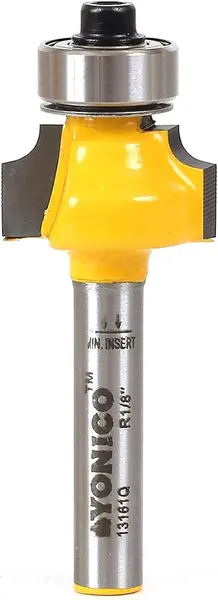
Yonico 13161q 1/8-inch radius roundover router bit with 1/4-inch shank and carbide cutters

First roundover bit

Shop Score 92/100
Shank Diameter
1/4 inch
Radius
1/8 inch
Cutter Material
C3 micro-grain carbide
Cutting Depth
1/8 inch
View on Amazon

The least expensive single bit in this group rounded an opening in red oak cleanly on the first pass and left an edge that needed no sanding — more than we expected at this price. Nothing about the cut announced a budget bit, and the profile matched the more expensive singles here.

The build explains part of it: C3 micro-grain carbide brazed to a hardened steel body, with the anti-kickback geometry that keeps a handheld router from grabbing in a corner. Two things to do before the first cut. Wipe the shipping oil off the shank — it arrives coated, and a slick shank in the collet is the one thing that lets a bit creep — and tighten the collet down firmly.

For the shop that cuts a roundover a few times a month, we think this is the sensible buy: the same edge break the premium bits cut, at a price that makes a second radius easy to justify later. If you're running cabinet doors all day and counting the seconds between bit changes, spend the difference. Most of us aren't.

Worth Noting

  • Burns if the router dwells in the cut
Our Verdict

We point budget-minded woodworkers here: the same 1/8-inch edge break the premium singles cut, for a fraction of what they cost.

Check Latest Price
4.

NICAVKIT 6-Piece Roundover Bit Set Best Range of Radii

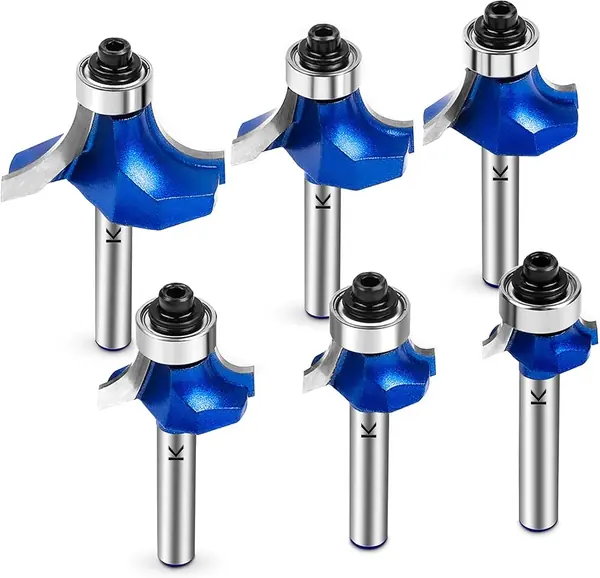
NICAVKIT six-piece roundover router bit set with 1/4-inch shanks and bearing guides

Full radius range

Shop Score 89/100
Shank Diameter
1/4 inch
Radii
1/8 to 1/2 inch
Number Of Bits
6
Blade Material
YG6 carbide
View on Amazon

A 1/2-inch round is a different tool from a 1/8-inch one. At the small end you're breaking an edge nobody consciously notices; at the top of this set you're shaping a tabletop or a thick shelf so the edge reads as deliberate from across the room. Having both in one box, with 3/8 and 5/16 between them, is the argument for a set over a single bit.

At roughly the price of one premium single, this is the set we recommend to anyone who builds furniture rather than trimming a shelf. You get all six radii, YG6 carbide blades in hardened 1045 bodies with anti-kickback shoulders, and a bearing guide on every bit, all on a 1/4-inch shank. Our advice: buy it before you commit to a radius, because cutting the same edge in four sizes on scrap tells you more than any chart.

Where the set gives ground is at the extremes. These are good bits, not boutique bits, and the 1/2-inch cutter is happiest in a table-mounted router where both hands stay on the workpiece. Treat the set as the thing that teaches you which radius you actually reach for, then upgrade the one or two you use most.

Worth Noting

  • Can burn hard woods at slow feed rates
Our Verdict

Six radii for about the price of one premium single makes this the set we hand furniture builders who want options.

Check Latest Price
5.

TOOLDO 4-Piece Roundover Bit Set Best Value Set

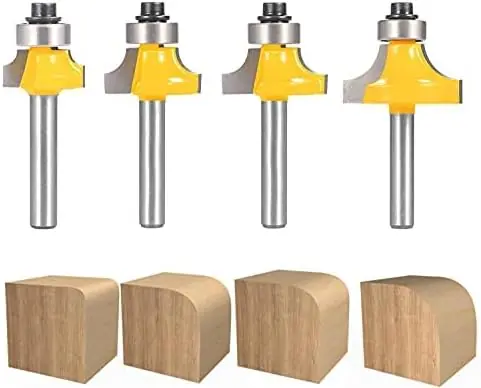
TOOLDO four-piece roundover router bit set with 1/4-inch shanks and bearing guides

Small-project edges

Shop Score 88/100
Shank Diameter
1/4 inch
Radii
1/8, 3/16, 1/4 and 5/16 inch
Number Of Bits
4
Cutter Material
C2 carbide
View on Amazon

Small boxes, jigs, picture frames and cabinet trim don't ask for a half-inch round — they ask for the 1/8 to 5/16 range, and this four-piece set covers exactly that without charging you for radii you'll never fit in a trim router. If your roundovers land on parts you can hold in one hand, you're the buyer for this.

The bits are C2 carbide inserts in hardened bodies with bearing guides, and they cut both softwood and hardwood cleanly, which is most of what a set at this price needs to do. The whole thing weighs in around four and a half ounces, so it lives in a tool bag without you noticing it — we kept reaching for it on trim runs where hauling out the bit box felt like more work than the cut.

What we think you get here is options without a commitment: four bits, a clean cut, and enough left over to buy the one radius you end up loving as a better single later. It won't put a furniture-scale round on a table edge, and it isn't trying to. For everything smaller than that, it's the set that keeps pace with you.

Worth Noting

  • Can leave a faint line above the bearing
Our Verdict

For small boxes, trim and jigs, this is the set we suggest: four useful radii at a budget price.

Check Latest Price
6.

NICAVKIT 4-Piece Small-Radius Set Best for Fine Detail Work

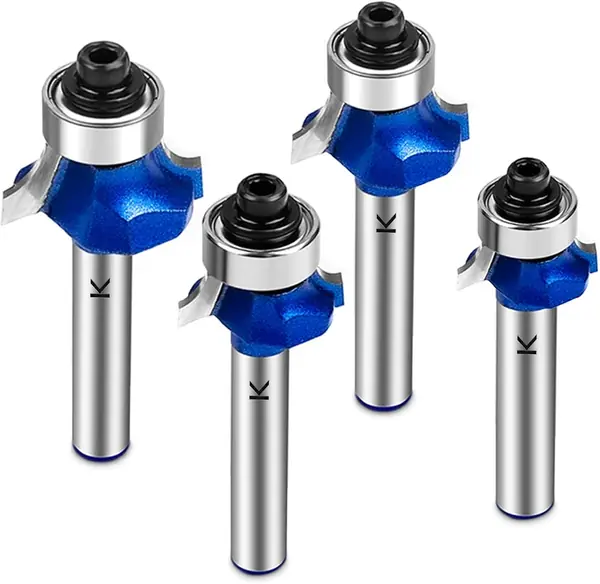
NICAVKIT four-piece small-radius roundover router bit set with 1/4-inch shanks

Fine detail work

Shop Score 87/100
Shank Diameter
1/4 inch
Radii
1/16, 1/8, 5/32 and 3/16 inch
Number Of Bits
4
Blade Material
YG6 carbide
View on Amazon

The 5/32-inch bit is what sold us on this set. It's the size that fixes an edge where 1/8 inch still reads sharp and 3/16 inch reads too round, and almost nobody sells it on its own. Four closely spaced small radii — 1/16, 1/8, 5/32 and 3/16 inch — make this the best fine-detail group here, and the one we reach for on boxes, small drawers and thin stock.

Construction is the same as the larger NICAVKIT set: YG6 tungsten carbide blades in hardened steel bodies with anti-kickback shoulders, bearing guides on a 1/4-inch shank. Small radii are where cheap bits expose themselves first, because a wobbly 1/16-inch cutter shows on the very first pass. These ran true.

Buy it if your projects are small and detailed. If a table edge or a bench apron later needs a round you can see from across the shop, that's a second purchase rather than a reason to pass on this one — and starting at the fine end teaches you more about feed and control than a half-inch bit does.

Worth Noting

  • Stops at 3/16-inch radius, requiring another bit for larger edges
Our Verdict

Our pick for fine detail: four small radii, including the 5/32-inch size that saves an edge the 1/8-inch bit leaves too sharp.

Check Latest Price

How We Tested Roundover Router Bits

We started by pulling every roundover bit we could find on a 1/4-inch shank, singles and sets alike, and narrowed the field by radius, carbide grade, bearing setup, and price so the shortlist put inexpensive single bits up against sets that cover several profiles. That left us with 14 bits from a handful of makers, which we ran for six months on a benchtop router table and in a handheld router.

Each bit got the same boards: red oak, maple, poplar, and plywood, with cross-grain passes along shelf edges and end-grain passes on cutting board blanks. We took light passes only, checked each bit's rated speed against the router before switching it on, and wore eye and hearing protection for every cut. After each pass we looked for scorching, fuzzy end grain, and tearout, and noted whether the edge needed sanding at all.

We also spun every bearing by hand to feel for play, swapped bearings where a bit allowed a second profile, and seated each shank in the collet to check fit and how much of the bit sat below the nut. Sharpness and edge holding were judged the same way: paring end grain with a fresh bit, then again after a long run of linear feet. To weigh sets against singles, we priced out what each set's extra radii would cost bought one at a time, and we noted how each bit balanced in a handheld router versus on the table.

How to Choose a Roundover Router Bit

Start With the Radius

An 1/8-inch bit breaks an edge you can feel but barely see. A 1/4-inch round is deliberate, the kind you notice on a shelf or an apron, and 3/8 and 1/2 inch are furniture-scale profiles. We steer most people to 1/8 inch first because it's the radius you'll use on nearly every project, then add size when a specific piece calls for it.

The trap is ordering a big radius for thin stock. The flat left on the edge equals the stock thickness minus twice the radius, so a 1/2-inch round on 3/4-inch stock leaves nothing flat at all — you've cut a bullnose, not a roundover. That same board with a 1/4-inch radius keeps a 1/4-inch flat land, which is what most furniture edges want.

Shank Size and Control

Every bit here uses a 1/4-inch shank, which is what trim and palm routers take. A 1/2-inch shank is stiffer and belongs in a bigger router, so check your collet before you order rather than after; an adapter sleeve is not the fix you want spinning at router speeds.

Control matters as much as the shank. Long boards run fine handheld with the bearing riding the edge. Anything shorter than about a foot is safer on a table with a push block, where your hands stay clear of the cutter and the bearing has a fence to run against.

Bearings Decide the Cut

The bearing is both the guide and the wear part. It rides the workpiece edge and sets how deep the profile cuts, so a bearing that seizes or works loose doesn't just spoil the line — the bit digs in. Spin every bearing with a finger before a run, brush out the packed dust, and replace one that feels rough instead of tolerating it.

Bearings are also the cheapest way to extend a bit. Fit a bearing 1/8 inch smaller in diameter on a roundover and it cuts a beading profile instead, which is a second bit for the price of a bearing. Any roundover will accept one if you buy the bearing separately.

One Bit or a Set

If you cut a single profile, one good bit is the better buy — you'll feel the difference in the cut, not in the drawer. A set makes sense when you're building furniture and want to test radii on scrap before committing, and the six-piece NICAVKIT spans 1/8 to 1/2 inch for about what one premium single costs.

Carbide grade, whether C2, C3 or YG6, matters most for how long an edge lasts rather than for the first cut; any of these will cut clean while fresh. What separates them over a year of use is whether the bearing holds up and the shank stays true.

Frequently Asked Questions

Final Verdict

The Freud 34-104 is where we start anyone who wants one roundover bit. It cuts end grain cleanly, gives you a proper 1/8-inch edge break, and a bearing swap adds a beading profile when you want a second look from the same cutter.

If the edges you cut go straight under finish and you want the smoothest surface off the bit, the Whiteside 2000C is worth the step up. If you build at more than one scale, skip both and buy the six-piece NICAVKIT set — the 1/2-inch bit in that box does work no 1/8-inch bit can.