↑↓ navigate ↵ open Esc close All results →

Best Sanders with Dust Collectors of 2026

What separates a clean refinishing session from a garage coated in fine gray film comes down to how well a sander captures dust right at the pad. With an effective bag, microfilter canister, or vacuum hose port, you spend far less time sweeping the bench and tacking surfaces before applying finish. Sanding a run of cabinet doors without active collection easily turns cleanup into the longest part of the project.

Across eight months of running 11 sanders on oak refinishing, drywall patches, paint stripping, and trim corners, onboard bags and canisters caught heavy shavings well enough, yet fine dust from MDF, drywall, and old paint still hung in the air. For those materials, a respirator, cross-ventilation, and a port that mates cleanly to a shop vac matter more than a larger onboard dust box.

Choosing among corded and cordless models, five-inch orbitals, and detail pads means balancing hose reach, battery cost, pad footprint, and replacement disc prices against how much airborne dust each design actually keeps off the bench.

Our Top Picks

The Best Sanders with Dust Collectors

1.

Bosch ROS20VSC Random Orbit Sander Best Overall
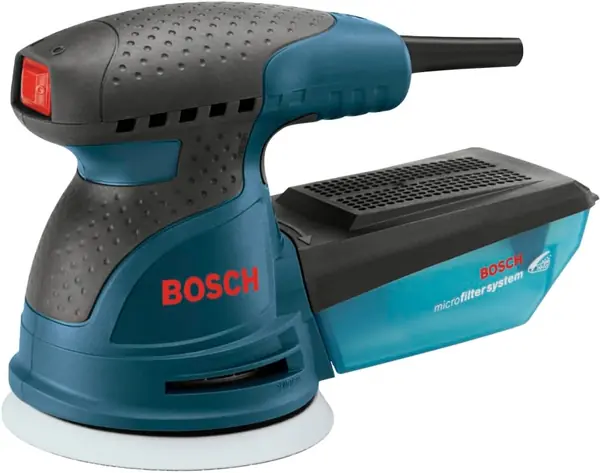
Bosch ROS20VSC 5-inch random orbit sander in blue with clear dust canister and soft bag

Finish sanding

Shop Score 96/100
Dust Collection
Microfilter canister and vacuum hose adapter
Weight
3.5 lb
Motor
2.5 amp
Speed Range
7,500-12,000 OPM
View on Amazon

The dust hardware is what put this Bosch on top: a clear microfilter canister rated to catch particles down to half a micron instead of spraying them across the bench, plus a vacuum hose adapter in the box so a shop vac can take over when the session runs long. The 2.5-amp motor turns 7,500 to 12,000 OPM on a dial, enough range to slow down for veneer and open up for paint removal.

Two things about using it stand out. It's the quietest 5-inch sander here — quiet enough that short jobs don't send us hunting for earplugs — and the soft-grip top keeps the vibration in the tool rather than in your wrist. Bosch's pad-dampening brake also stops the disc fast when you lift off, which is the detail that keeps swirl marks out of a panel you've already sanded twice.

The 5-inch pad is the standard size, so paper is everywhere, and the pliable backing pad follows a curve better than the flatter pads on most of these. At 3.5 pounds it's heavier than the cordless DeWalt, and like every round orbital here it's useless in an inside corner, which is a detail sander's job.

Where it wins for us is the combination: the best dust capture in this group, a genuinely smooth finish, and a price that sits in the middle of this list rather than at the top of it. If your shop is a garage you also park in, that first point is the one that decides it.

Worth Noting

  • Canister is stiff to twist open and reseat
  • One-year warranty, shorter than DeWalt's three-year coverage
Our Verdict

We recommend the Bosch ROS20VSC to woodworkers who want the least dust and the smoothest finish: its canister, hose adapter, and quiet 2.5-amp motor make it the easiest sander here to live with.

Check Latest Price
2.

DeWalt DWE6423K Random Orbit Sander Best Corded Workhorse

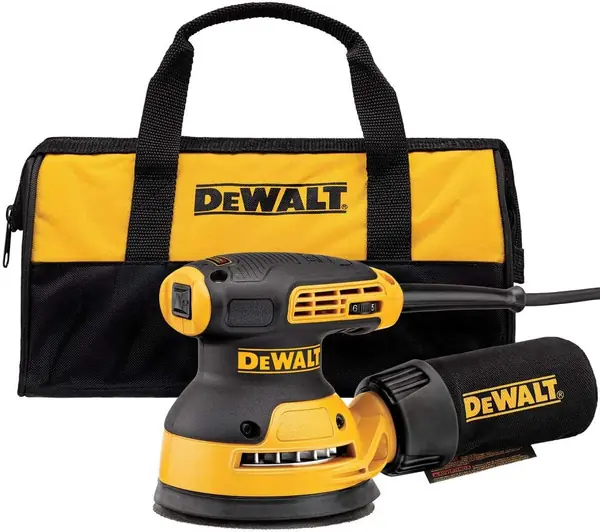
DeWalt DWE6423K 5-inch corded random orbit sander in yellow with dust bag and carrying bag

Paint removal

Shop Score 95/100
Dust Collection
Locking dust bag and DeWalt vacuum port
Motor
3 amp
Speed Range
8,000-12,000 OPM
In The Box
Dust bag and carrying bag
View on Amazon

Compare this DeWalt to the Bosch and the difference is temperament. The Bosch is the careful one; this is the one you lend to a friend who's about to strip a whole deck. The 3-amp motor runs 8,000 to 12,000 OPM, the kit arrives with a locking dust bag and a carrying bag, and the pad takes the standard 5-inch hook-and-loop discs everyone stocks.

Our favorite thing about it is the separate counterweight. DeWalt isolates it from the pad, and after twenty minutes of sanding cabinet doors overhead, that's the difference between finishing the job and quitting for the night. The bag locks on with one hand and swallowed most of the sawdust from 120-grit work in our sessions; if you already own a DeWalt shop vac, the port connects straight to the DWV010 or DWV012.

Durability is where this one has earned our trust — the tool feels dense and settled in the hand, and the pad and clamp have taken repeated paper changes without complaint. For stripping paint, flattening a glue-up, or prepping a deck, the extra amperage over the Bosch is worth having.

Worth Noting

  • Short cord often needs an extension cord
  • Needs a separate adapter for non-DeWalt hoses
Our Verdict

If your projects start with 60-grit and end in a pile of sawdust, this is the corded sander we hand people — 3 amps, low vibration, and a dust bag that stays put.

Check Latest Price
3.

DeWalt 20V MAX DCW210B Orbital Sander Best Cordless

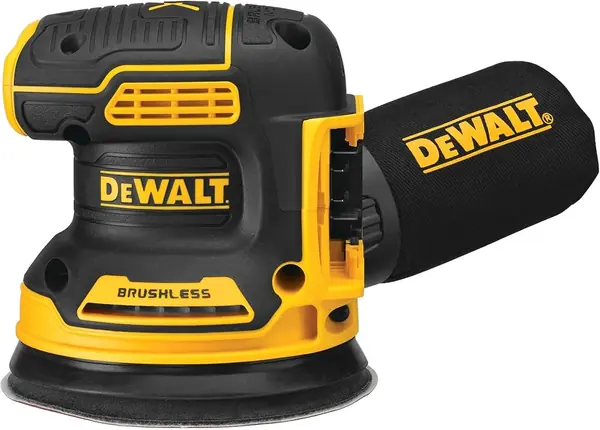
DeWalt 20V MAX cordless 5-inch random orbit sander in yellow and black with dust bag

Cord-free work

Shop Score 94/100
Dust Collection
Dust bag and vacuum connection
Weight
2.5 lb
Speed Range
8,000-12,000 OPM
Power Source
20V MAX lithium-ion (tool only)
View on Amazon

There's no cord to fight, and that's the entire argument. Sanding a fence line, a stairwell, or a piece clamped to a sawhorse in the driveway normally means dragging an extension cord and re-plugging every few minutes; with this DeWalt you clip in a 20V pack and go. We think it's the most useful sander here for anyone whose work happens away from an outlet.

In the hand it's 2.5 pounds with a low profile, so it sits flat on a rail without the motor housing dragging, and the 8,000 to 12,000 OPM dial gives you the same control as the corded version. Runtime depends entirely on the pack you feed it — a 5.0 Ah battery outlasts a compact pack by a wide margin, so plan on the bigger one if you have long sessions ahead.

Be realistic about the job it wants: continuous all-day sanding is where this one is most likely to struggle, and it's happiest as a homeowner's tool that runs for half an hour at a time. Used that way, the dust bag catches the bulk of the sawdust and the 8-hole discs change in seconds.

Worth Noting

  • Tool only; battery and charger sold separately
Our Verdict

Our cordless pick for anyone already stocked with DeWalt 20V batteries: no cord to fight, real variable speed, and dust collection that handles small jobs.

Check Latest Price
4.

SKIL SR211601 Random Orbital Sander Best Budget

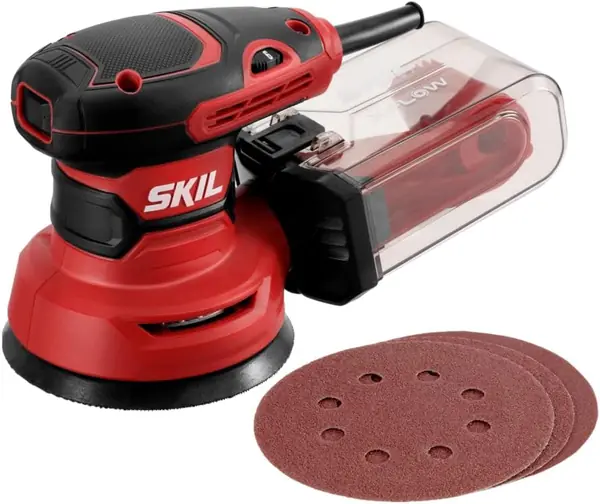
SKIL SR211601 5-inch random orbital sander in red and black with clear cyclonic dust box

Occasional sanding

Shop Score 93/100
Dust Collection
Cyclonic dust box
Weight
3.4 lb
Motor
2.8 amp
Speed Range
7,000-13,000 OPM
View on Amazon

Least expensive doesn't have to mean least capable. This SKIL is the cheapest variable-speed 5-inch orbital we recommend, and the numbers don't read like a budget tool: 2.8 amps, 7,000 to 13,000 OPM on a dial, and a cyclonic dust box instead of a cloth bag.

The X-Flow box spins dust into a clear cup you can see through, which makes it obvious when to empty it. The catch is fit: the box can work loose during a long pass, and the outlet isn't sized to slip over a shop vac nozzle, so you can't simply tape on a hose and forget it. Empty it often and keep a hand near the tool on big panels.

As a second sander it makes a lot of sense — the one that lives on the shelf for a shelf build or a railing, where a knock or a drop isn't a disaster. It also runs smoother than the money suggests, with the counterweight keeping vibration out of your fingers.

Worth Noting

  • Best suited to occasional use, not daily production
Our Verdict

A genuine variable-speed 5-inch orbital for the least money here, and the right buy when sanding is an occasional chore rather than a daily trade.

Check Latest Price
5.

WEN 6301 Detailing Palm Sander Best for Trim and Corners

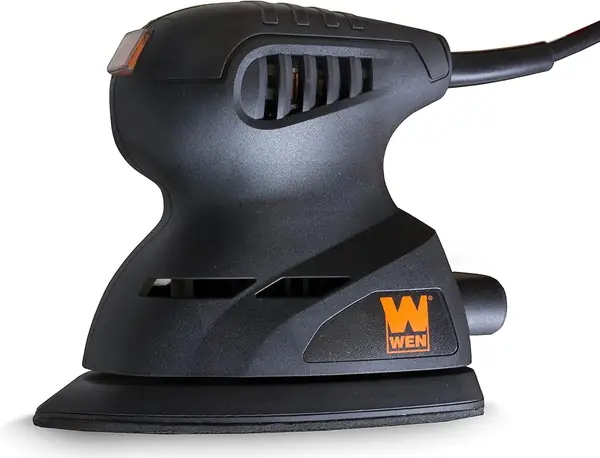
WEN 6301 palm-sized detail sander in orange with angled pad and dust port

Trim and corners

Shop Score 92/100
Dust Collection
Dust port (bag not included)
Weight
2 lb
Orbits Per Minute
13,500 OPM
Pad Size
3.75 x 5.5 inches
View on Amazon

Two pounds is the whole story. The WEN sits in your palm, the pad is a 3.75-by-5.5-inch rectangle with an angled nose, and 13,500 OPM moves it fast enough to be useful rather than decorative. This is the one we reach for when a 5-inch orbital can't get in — window muntins, the inside corners of a face frame, the curve on a chair leg.

Dust runs through a port on the body for a vacuum hose rather than a bag, so plan on having a vac at the other end of the job. With one connected it does what a detail sander can about dust, which is keep the worst of it off the workpiece. Paper changes are hook-and-loop and take a second, and nothing about the tool feels like a toy.

Worth Noting

  • Light motor bogs down on coarse grits
Our Verdict

This is the detail sander we point beginners to: light, easy to steer into corners, and the least expensive way into the format.

Check Latest Price
6.

SKIL SR250801 Detail Sander Best for Detail Work

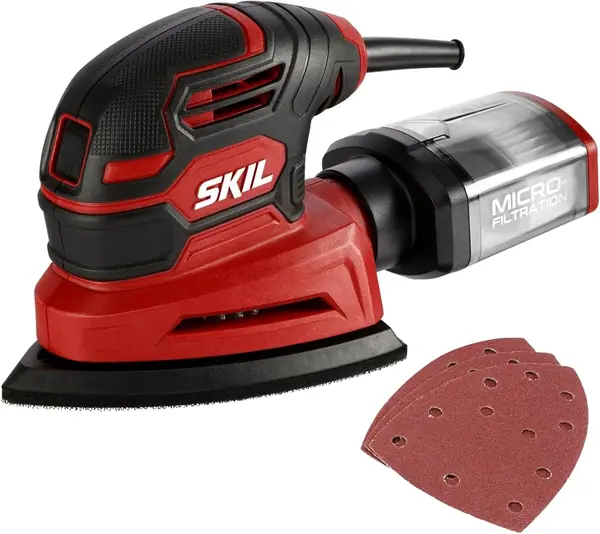
SKIL SR250801 corded detail sander in red with pointed pad and micro-filter dust box

Detail work

Shop Score 91/100
Dust Collection
Micro-filter dust box and 1-1/4 in. vacuum port
Weight
2.3 lb
Motor
1 amp
Orbits Per Minute
12,000 OPM
View on Amazon

The nose is the point. A pointed pad gets into corners and along stair nosing where a round 5-inch disc simply can't reach, and this SKIL weighs 2.3 pounds with a soft-grip body and hook-and-loop paper that changes in seconds. It arrives with a micro-filter dust box, three sanding sheets, and the part that matters here — a 1-1/4-inch port that takes a shop vac hose.

That port is why we rank it above the WEN for indoor work: screw a hose on and the fines go into the vac instead of settling on the furniture you just moved out of the way. Twelve thousand orbits per minute is plenty for detail work and gentle enough that the pad doesn't gouge a profile, and the pointed shape lets you work a corner without tipping the tool up on its edge.

Worth Noting

  • Dust box alone lets fine dust through
Our Verdict

The detail sander we choose when a shop vac is part of the plan — that 1-1/4-inch port is what makes it worth more than the cheaper WEN.

Check Latest Price
7.

BLACK+DECKER BDERO100 Orbital Sander Best for Light House Projects

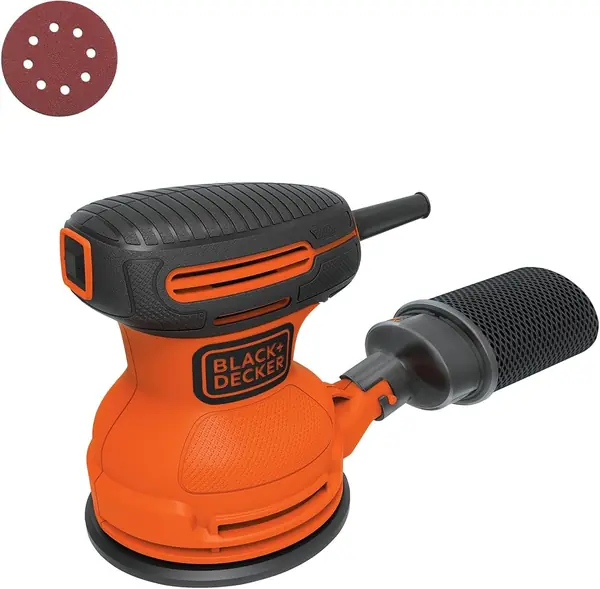
BLACK+DECKER BDERO100 5-inch corded random orbit sander in orange and black with dust bag

Light house projects

Shop Score 90/100
Dust Collection
Built-in dust bag
Weight
3.2 lb
Motor
2.0 amp
Orbits Per Minute
12,000 OPM
View on Amazon

For a door edge, a windowsill, or a table you're about to paint rather than refinish, this is the sander we hand to someone who doesn't want a project. It weighs 3.2 pounds, the paddle switch locks on so your hand can relax, and the 2.0-amp motor turns 12,000 OPM — modest numbers that suit light work.

Hook-and-loop paper changes in seconds, the soft overmold keeps the tool controllable one-handed, and the bag collects the coarser dust from a light pass. The 5-inch pad takes the same discs as the Bosch, so you're not buying a second set of paper to keep this one fed.

Where it earns a place is as a household tool rather than a shop tool: short sessions, softwood, a coat of paint afterward. Lean on it for a full weekend of hardwood and it heats up, because the 2.0-amp motor is doing everything it can. That's the honest boundary of what this one is for.

Worth Noting

  • Bag-only dust collection, no vacuum port
  • Light-duty build that heats up under load
Our Verdict

A light, inexpensive orbital for occasional house projects; we like it for door edges and quick scuffs, not for a weekend of hardwood.

Check Latest Price

How We Tested the Best Sanders for Dust Control

We started by pulling every sander with a dust collector we could find at mainstream retailers, then filtered that list by how the dust gets captured — cloth bag, microfilter canister, dust box, or hose port — along with pad format, power source, amperage, and the price of replacement discs. From there we bought 11 and put them to work in a home shop and on a hallway full of drywall patches over eight months.

Each one spent time on pine boards, oak, MDF shelving, and old paint on a porch railing, and we ran a ten-minute stretch with a black trash bag taped flat beneath the work to see what escaped and where it landed. Then we attached a shop vac to every hose port and repeated the run. The bags and boxes caught the coarse debris; the fine dust from MDF and old paint still hung in the air, so those sessions ran with eye and hearing protection, a respirator, and the garage door open.

We logged how our hands felt after twenty minutes of continuous sanding and how loud each sander ran in an empty garage. We timed disc and paper changes with a stopwatch and counted how many sheets a project ate, which is where an inexpensive sander quietly stops being inexpensive. Corded models went a full Saturday without a break; the cordless one we measured in boards per charge, and we noted which sanders needed a hose adapter or a battery purchased separately before they would do the job properly.

After the first round, the sanders that held up stayed in rotation for a second set of projects, where we watched for wobble in the pad, fraying at the cord, and switches gone mushy — the failures that only show up after a few months of weekends.

How to Choose a Sander With Dust Collection

Bag, Canister, or Hose

Every sander here collects something, but they don't collect the same way. A cloth bag knocks down chips and coarse dust and lets the fines pass through. A microfilter canister — the Bosch and both SKIL detail models use one — traps much finer particles and usually shows you when it's full. The best setup is a port that accepts a shop vac hose, either in place of the bag or alongside it.

The trap is sizing. A 1-1/4-inch port is common on detail sanders, but DeWalt's port needs the DWV9000 adapter to meet a standard hose, and some dust boxes aren't designed for a hose at all. Check the port before you assume your vac will fit.

Corded or Cordless

Corded sanders run all afternoon without a thought about runtime, and they're the better value if the tool stays in the shop. Cordless is the answer for a fence line, a stairwell, or a site with one distant outlet — the DeWalt 20V is our cordless pick here.

Two cautions. Cordless sanders are often sold as bare tools, so battery and charger land on top of the purchase price, and sanding is a heavy electrical draw, so a compact pack won't last long. Budget for the largest battery you can justify.

Match the Pad to the Work

A 5-inch random orbit sander — the palm sander shape most of us picture — handles flat panels, decks, and paint removal. Its round pad can't reach an inside corner, which is exactly what detail sanders are for: pointed pads, narrow fingers, and lighter motors for trim, spindles, and stair parts.

Most small shops do better with one of each than with a single compromise tool, since detail paper and 5-inch discs aren't interchangeable. If you refinish furniture, a detail sander earns its shelf space fast.

Speed Control, Vibration, and Noise

Variable speed matters more than raw amperage once you're past stripping: 7,000 to 13,000 OPM lets you slow down over veneer and painted trim instead of burning through it. Single-speed tools are fine for rough work and frustrating for finish work.

Vibration is the spec nobody prints. A separate counterweight, a soft-grip top, and a pad dampener decide whether you can sand for an hour or for twenty minutes, and we weight those heavily when we choose. Noise matters for the same reason — the quietest sander here is the one we reach for first on a small job.

Frequently Asked Questions

Final Verdict

The Bosch ROS20VSC is the sander we recommend first. It captures the finest dust of anything here, runs quietly with little vibration, and its speed dial covers everything from veneer to paint removal.

If your work starts with 60-grit and a lot of material to move, the DeWalt DWE6423K's extra amperage and lower vibration are worth the step up. And if sanding is an occasional Saturday job rather than a trade, the SKIL SR211601 does the same 5-inch work for a fraction of the money.